Last updated:
Disease groups:
Chikungunya virus spreads to humans through bites from infected mosquitoes. It can be serious. The best protection is to prevent mosquito bites. We support national monitoring of chikungunya, including national case numbers and trends.
Chikungunya is a mosquito-borne virus, which spreads through bites from infected mosquitoes.
Most people recover quickly from chikungunya, but it can cause severe, long-term health problems especially for people in high-risk groups.
Chikungunya is not endemic to Australia, but it is a major global health concern with millions of infections diagnosed every year around the world.
Outbreaks in Africa, Asia, the Americas, the Western Pacific and Europe have led to a rise in chikungunya infections worldwide in 2025.
There is no specific treatment for chikungunya. Infection can result in serious, long-term complications.
In rare cases, chikungunya can cause severe disease in newborn babies if a pregnant person gets infected.
Chikungunya has not been detected in mosquitoes in Australia. But the mosquito species that transmit the virus are present in northern Queensland and the Torres Strait.
This means that outbreaks could occur in Australia.
If you’re looking for advice about your own health or treatment options, see healthdirect or speak with a qualified healthcare professional. Our role is to provide public health advice – information and guidance that helps prevent disease, protect communities and improve wellbeing at a population level.
Common symptoms include:
Most people with chikungunya virus recover from serious illness within 1 to 2 weeks and develop lifelong immunity. In some people, joint pain can persist for months or years.
Severe illness is more likely for some groups of people and can include:
Read more about symptoms, diagnosis and treatment of chikungunya virus.
healthdirect’s symptom checker can help you decide whether to see a health professional.
Symptoms usually start between 3 and 7 days after a bite from an infected mosquito, but can range from 1 to 12 days.
Mosquitoes become infected with chikungunya virus when they bite someone with the virus in their blood. They then pass on the virus when they bite another person.
The mosquito species that transmit chikungunya can bite during the day, but are most active in the few hours after sunrise and before sunset.
Chikungunya does not transmit directly from person to person.
In rare cases, chikungunya can spread:
People with chikungunya can spread the virus to mosquitoes for up to 7 days after their symptoms start.
There is no vaccine for chikungunya available in Australia.
The best way to protect against chikungunya is to prevent mosquito bites.
If you become unwell with a high fever during or soon after travelling to a place where chikungunya is found, speak to your healthcare professional as soon as possible.
If you have chikungunya, it is important to prevent mosquito bites while you have a fever. This is because you could pass the virus to mosquitoes, which can then spread the virus to other people.
Some people are at greater risk of getting chikungunya or of getting very sick from it.
If you are at greater risk, it is especially important to:
Chikungunya poses a greater risk of severe illness for:
You are at greater risk of being exposed to chikungunya if you travel to places where chikungunya occurs.
If your health professional suspects you may have chikungunya, they will usually refer you for a blood test.
You can use healthdirect’s directory to find a health service near you.
There is no specific treatment for chikungunya. You can take pain-relief medicines to help with joint pain.
If you have symptoms of chikungunya, do not take anti-inflammatory medicines – like aspirin or ibuprofen – until your health professional has ruled out dengue fever, as they increase the risk of bleeding.
Read more about how to manage or treat chikungunya.
Chikungunya is a nationally notifiable disease – these are diseases that present a risk to public health.
Health authorities in each state and territory report new cases to us through the National Notifiable Diseases Surveillance System.
This is part of national surveillance activities to monitor case numbers around the country and understand disease patterns.
We analyse the data and publish case numbers and other data through our data visualisation tool, where you can filter and search the latest information.
Any chikungunya infection acquired in Australia is considered an outbreak.
How public health agencies respond to chikungunya cases and outbreaks depends on:
During outbreaks, steps to control the disease may include:
For information about chikungunya in your state or territory see:
For travel advice, see Smartraveller.
Chikungunya virus is a mosquito-borne alphavirus in the family Togaviridae. It is related to Ross River and Barmah Forest viruses.
Humans and non-human primates, such as monkeys, are the reservoir for chikungunya virus.
Symptoms typically include:
Most people recover from the acute illness within 1 to 2 weeks. In some, the arthralgia can persist for months or years.
Severe complications are more likely to occur in older people who have other health conditions, and include:
Chikungunya rarely causes death.
Most people who have been infected with chikungunya virus develop lifelong immunity.
Read more about symptoms, diagnosis and treatment of chikungunya virus.
Chikungunya is a global health concern, with regular large outbreaks in endemic countries.[1]
There is no specific treatment for chikungunya infection, which can cause severe long-term complications.
The disease places a substantial burden on individuals, communities, and health systems, particularly in tropical and subtropical regions.
Chikungunya virus has not been reported in mosquitoes in Australia. But the mosquito species that transmit the virus are found in:
This means outbreaks of chikungunya could occur in Australia.
Because of the potential impacts of chikungunya, we:
Globally, chikungunya virus circulates in more than 100 countries, with many millions of cases reported each year.[1]
Outbreaks overseas – including in parts of Africa, Asia, Americas, the Western Pacific and Europe – have caused a significant increase in the number of chikungunya infections diagnosed in 2025.
In Australia, there have been no known locally acquired chikungunya cases.
Travel-related infections are reported in Australia each year. They are most common among people who have been in regions where chikungunya is endemic or outbreaks are occurring.
For the latest information on chikungunya incidence in Australia see the National Notifiable Diseases Surveillance System (NNDSS) data visualisation tool.
Chikungunya virus spreads through the bites of infected mosquitoes – mainly Aedes aegypti and Aedes albopictus.
These mosquitoes bite during the day, but are especially active in the few hours after sunrise and before sunset.
Chikungunya virus does not transmit directly from person to person, but mosquitoes can spread the virus between people.
Rarely, chikungunya virus can spread:
Symptoms usually begin between 3 and 7 days after a bite from an infected mosquito, but can range from 1 to 12 days.
A person with chikungunya can transmit the virus to mosquitoes that bite them for up to 7 days after the onset of symptoms.
Chikungunya poses a greater risk of severe illness for:
Read more about measures people can take to protect themselves.
People are at greater risk of exposure to chikungunya virus if they travel to endemic regions or places with active outbreaks.
Read more about:
Chikungunya outbreaks could occur anywhere where Aedes species mosquitoes are located.
Read more about:
There is no vaccine against chikungunya available in Australia.
The best protection against chikungunya is to prevent mosquito bites.
The mosquitoes that spread chikungunya virus bite during the day. They are most active at dawn and dusk.
People who become unwell with a high fever during or soon after travel to a region where chikungunya is circulating should seek medical advice as soon as they can.
Chikungunya virus infection is usually diagnosed through laboratory testing of a blood sample in a person with clinically compatible illness to detect:
If chikungunya virus infection is part of a differential diagnosis, it’s important to specifically request chikungunya testing when referring patients to pathologists.
Read more about testing and diagnosis of chikungunya.
There is no specific treatment for chikungunya. Clinical management consists of supportive care.
Anti-inflammatory medicines – such as aspirin or ibuprofen – must be avoided until dengue fever has been ruled out, to reduce the risk of bleeding.
Read more about the treatment of chikungunya.
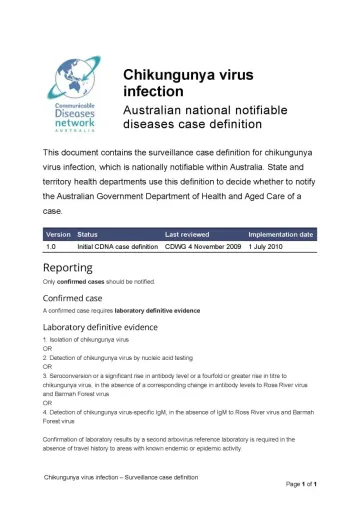
Chikungunya is a nationally notifiable disease. This means certain health professionals must report diagnoses through their relevant health authorities.
Check how to report laboratory-confirmed chikungunya cases or related death in your state or territory:
State and territory health authorities report new cases to us daily through the National Notifiable Diseases Surveillance System, as part of our surveillance activities.
We report case numbers and other data through our data visualisation tool, where you can filter and search the latest information.
This helps us to:
Public health units urgently investigate cases of chikungunya, with a focus on determining the likely source of the infection.
Chikungunya cases in Australia without a relevant overseas travel history require further investigation and might require a public health response.
The person affected should be provided with information about:
Public health authorities might follow up people who were exposed to the same source as a confirmed chikungunya case. This can include people who:
Public health authorities provide people who might have been exposed with information about:
Any locally acquired chikungunya case is considered an outbreak.
How public health agencies respond to chikungunya cases and outbreaks depends on:
Control measures used during outbreaks may include:
A case of chikungunya who has travelled to northern Queensland or the Torres Strait, where Aedes mosquitoes are present, may require extra public health actions.
See:
For more information relevant to your state or territory, see:
For information of staying safe from chikungunya while travelling, see Smartraveller.