

Last updated:
At a glance
- Vaccine preventable – check who’s eligible
- Vaccine included on the National Immunisation Program – check who’s eligible
- Nationally notifiable disease
About invasive meningococcal disease
Invasive meningococcal disease (IMD) is a rare but serious infection. It is caused by the bacterium Neisseria meningitidis.
Most disease is caused by the serogroups A, B, C, W and Y.
IMD is a medical emergency that progresses quickly and can result in death. It can cause fever, a red or purple rash, meningitis and sepsis. If you are concerned you or someone you care for might have IMD, immediately go to an emergency department or call 000.
Why it matters to public health
IMD causes severe illness or death – up to 1 in 10 people with the disease die, and 1 in 3 people have lifelong impairment.
IMD is more common in children aged under 5 years and adolescents. Aboriginal and Torres Strait Islander people also have higher rates of IMD than other people.
The disease has wide-ranging impacts – social, emotional and economic – on both families and the community.
Vaccination has significantly reduced the number of IMD infections in Australia.
Because of the seriousness of IMD, we:
- monitor and report on IMD infections in Australia
- plan for how to manage outbreaks.
Symptoms
If you’re looking for advice about your own health or treatment options, see healthdirect or speak with a qualified healthcare professional. Our role is to provide public health advice – information and guidance that helps prevent disease, protect communities and improve wellbeing at a population level.
Meningitis (inflammation of the lining of the brain) is the most common presentation of the disease.
Symptoms can include:
- fever that starts suddenly
- headache
- neck stiffness
- light sensitivity
- nausea
- vomiting
- drowsiness, confusion or loss of consciousness
One in 3 people present with sepsis only. Symptoms can include:
- fever and chills
- cold hands and feet
- severe muscle and joint pain
- abdominal pain
- vomiting
- diarrhoea.
Babies and young children might have other symptoms, including:
- fever
- irritability
- a high pitch cry
- tiredness and floppiness
- pale or blotchy skin
- poor feeding
A late sign of the disease is a red or purple rash that does not fade under pressure.
Serious complications include:
- hearing loss
- vision loss
- loss of limbs
- learning difficulties.
Read more about the symptoms, diagnosis and treatment of IMD.
healthdirect’s symptom checker can help you decide whether to see a health professional.
Onset of symptoms
Symptoms usually start 3 to 4 days after infection, but can range from 1 to 10 days
How it spreads
Meningococcal bacteria do not spread easily. It takes close, prolonged contact with a person who carries the bacteria in the back of their throat or nose.
At any given time, up to 1 in 4 healthy people are carriers of meningococcal bacteria.
It spreads through:
- droplets from the respiratory tract – for example, when coughing or sneezing
- secretions from the throat – for example, when kissing deeply.
It is not easily spread through sharing drinks or food.
Infectious period
People carrying meningococcal bacteria can spread the bacteria to others until they clear the bacteria from the back of their nose and throat. This occurs naturally (without treatment) and can take months or years.
Prevention
Vaccination
Getting vaccinated is the best way to protect against IMD – it is recommended for anyone aged 6 weeks and older.
Vaccination is recommended for specific groups, including:
- infants, children, adolescents and young adults
- Aboriginal and Torres Strait Islander people
- people with specified medical conditions
- laboratory workers who regularly handle the bacteria
- some travellers
- young adults who live in close quarters or who are current smokers.
There are 2 IMD vaccines – one covers meningococcal ACWY and the other covers meningococcal B.
Vaccination protects against the most common – but not all – serogroups.
Eligible people can get meningococcal vaccines for free under the National Immunisation Program or state or territory programs. If you are not eligible for a free vaccine, you can buy one from your health professional or pharmacy.
Read more about IMD vaccination.
Priority groups and settings
Some people are at greater risk of developing IMD or of getting very sick from it.
If you are at greater risk, it is especially important to get vaccinated.
People at greater risk of severe disease
IMD is a severe illness.
People at higher risk of being infected and developing IMD include:
- young children and babies, especially those aged 12 months or under
- Aboriginal and Torres Strait Islander people
- people aged 15 to 24 years
- people who are immunocompromised
- people exposed to cigarette smoke.
Although rare, people can get IMD more than once, especially those who are immunocompromised.
People at greater risk of exposure
Most IMD is sporadic and happens after prolonged, close contact with an asymptomatic carrier.
People who live with, kiss deeply with, or are sexual partners of, someone who has IMD are at greater risk of exposure.
Some people are also more likely to be exposed to meningococcal bacteria because:
- of their job
- they live in close quarters with others, such as
- students in residential accommodation
- people in military barracks
- they travel to countries where invasive meningococcal disease is more common
- they are pilgrims travelling to Mecca for the Hajj or Umrah.
Diagnosis and treatment
IMD requires urgent medical attention and treatment, often in an intensive care unit.
It can be diagnosed through tests that might include a:
- spinal fluid test (lumbar puncture)
- blood test
Other tests might be needed, depending on a person’s symptoms.
You can use healthdirect’s directory to find a health service near you.
IMD treatment involves intravenous antibiotics and other medicines.
Read more about how to manage or treat IMD.
Surveillance and reporting
IMD is a nationally notifiable disease – these are diseases that present a risk to public health.
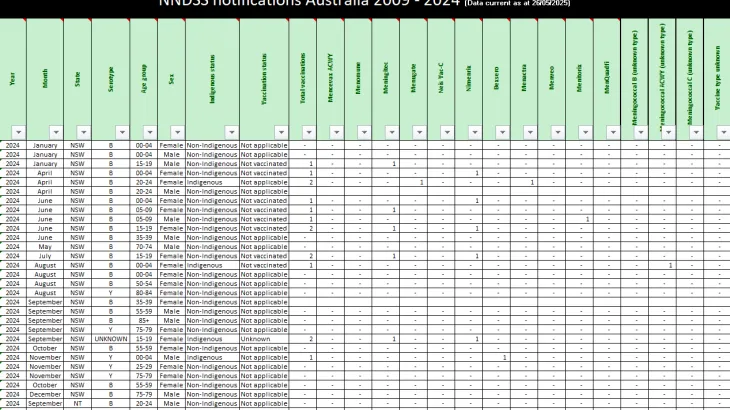
Health authorities in each state and territory report new probable and confirmed IMD cases to us daily through the National Notifiable Diseases Surveillance System.
This is part of our surveillance activities, which help us monitor IMD case numbers around the country and understand disease patterns.
We analyse the data and report on case numbers and other data through our data visualisation tool, where you can filter and search the latest information.
Outbreaks
For every person with IMD, the public health response focuses on stopping spread to prevent other people getting the disease.
Contact tracing is used to identify people who had close contact to a person with IMD.
Close contacts might be offered:
- education about the disease, its symptoms and how it is spread
- clearance antibiotics – these get rid of the meningococcal bacteria from the nose and throat to help prevent the spread but do not protect against developing IMD
- vaccination.
Read more about how the Australian Government defines and plans for outbreaks.
Support
For more information about IMD, see:
For information about IMD in your state or territory, see:
- Australian Capital Territory
- New South Wales
- Northern Territory
- Queensland
- South Australia
- Tasmania
- Victoria
- Western Australia.
If you need mental health support, see a list of organisations, websites and services that offer support, counselling and information.
For information on staying safe from IMD while travelling, see: