Last updated:
Disease groups:
Measles is a highly contagious viral illness. It can be very serious and cause hospitalisation or death. Getting vaccinated is the best protection. We monitor and report on measles in our community, including national case numbers and trends. We provide guidelines to minimise the risk of spread.
Measles exposure locations have recently been identified in some states and territories.
For the latest information, check the advice in your state or territory:
Measles is a highly contagious illness caused by a virus. It can be very serious and can cause hospitalisation and death.
Vaccination is the best way to prevent illness and the spread of measles.
Measles can be very serious, especially in people who are unvaccinated or have weakened immune systems.
Measles infection during pregnancy increases your risk of miscarriage and pre-term labour.
Being extremely contagious, measles can spread quickly.
It is vaccine preventable – the measles vaccine is safe and highly effective in protecting people from infection and serious complications.
Measles was common in Australia before measles vaccination was added to the childhood immunisation program in the 1970s. Thanks to our vaccination program, Australia has eliminated local transmission of measles.
But cases continue to occur in Australia, mostly in people who have travelled overseas.
Measles continues to spread in many countries worldwide.
We monitor and report on measles cases in Australia. This helps to identify and manage measles cases and contacts to reduce the risk of spread.
If you’re looking for advice about your own health or treatment options, see healthdirect or speak with a qualified healthcare professional. Our role is to provide public health advice – information and guidance that helps prevent disease, protect communities and improve wellbeing at a population level.
Measles usually starts with a flu-like illness that lasts 2 to 4 days. Common symptoms include:
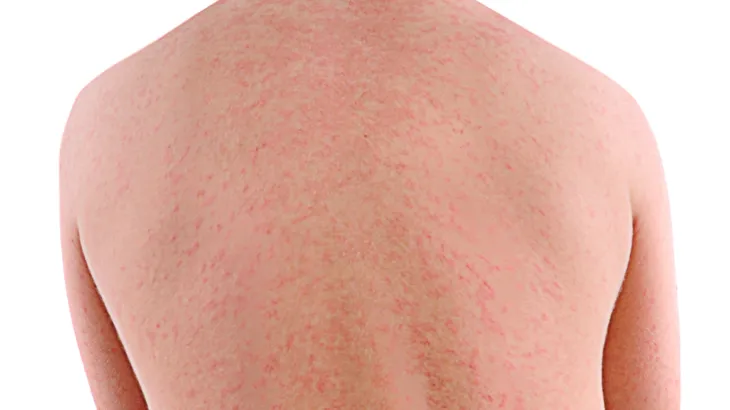
A non-itchy, red and blotchy rash appears 2 to 7 days after symptoms start. The rash usually starts on the face or upper neck and then spreads to the body. It lasts for 4 to 7 days.
Measles is often severe. Complications can include:
healthdirect’s symptom checker can help you work out whether you need to seek medical help.
Symptoms usually start 7 to 18 days after getting infected.
Measles is extremely contagious. Up to 9 out of 10 people who are not immune will become infected if they are exposed to an infected person. This can be through:
The measles virus can stay in the air inside or on surfaces and infect others for up to 2 hours.
People with measles are infectious from the day before their symptoms start until 4 days after the rash appears.
Vaccination is the best way to protect against measles for people not already immune.
You should be immune to measles if you have either:
People in Australia who were born before 1966 are generally considered to be immune to measles, as it’s highly likely they had measles during childhood.
Measles vaccines are safe and effective. Two measles vaccine doses are 99% effective at preventing infection from the virus.
Eligible people can get measles vaccines for free under the National Immunisation Program or state or territory programs. If you are not eligible for a free vaccine, you can buy one from your healthcare professional or pharmacy.
You should not get vaccinated if you:
You should avoid pregnancy for 28 days after you receive a measles vaccination.
Check with your healthcare professional for advice about measles vaccination.
At least 6 weeks before you travel overseas, talk to your healthcare professional about:
To protect others, if you have or are suspected of having measles, you should:
Some people are at greater risk of getting measles or of getting very sick from it.
If you are at greater risk, it is especially important to talk to your healthcare professional about measles vaccination and other ways to protect yourself.
Measles spreads quickly in households and crowded places, including:
Measles poses a greater risk of severe illness for:
People who live, work, or share the same airspace as a person infected with measles are at risk of becoming infected.
People are at greater risk of being exposed to measles if they:
If you think you might have measles or have been in contact with someone who has measles, call your healthcare professional straight away.
They can diagnose measles with a test, which might require:
You can use healthdirect’s directory to find a health service near you.
There is no specific treatment or medicine for measles. But there are treatments to help with the symptoms and treat any complications. Talk to your healthcare professional.
If you have severe symptoms or complications, you might need treatment in hospital.
Antibiotics are not used to treat measles because they do not work for viral infections. Taking antibiotics when you don’t need them can increase the risk of antibiotic resistance.
Measles is a nationally notifiable disease – these are diseases that present a risk to public health.
Health authorities in each state and territory report new laboratory confirmed cases to us daily through the National Notifiable Diseases Surveillance System.
This is part of our surveillance activities, which help us monitor case numbers around the country and understand disease patterns.
We analyse this data, and report on measles case numbers through our data visualisation tool, where you can filter and search the latest information.
In measles outbreaks, the public health response focuses on quickly identifying and isolating infected people.
Contact tracing is used to identify people who might have been exposed to an infected person, especially those at greater risk of severe disease.
Contacts might be quarantined and offered vaccination or an injection of antibodies to reduce their risk of getting measles.
Read more about how the Australian Government defines and plans for outbreaks and pandemics.
For information about measles in your state or territory see:
For information on staying safe from measles while travelling, see:
The measles virus is a member of the genus Morbillivirus (a paramyxovirus).
Measles typically starts with a prodrome that last 2 to 4 days and includes:
A non-itchy, maculopapular rash appears 2 to 7 days after onset of symptoms. It usually starts on the face or upper neck and spreads to become generalised. The rash typically lasts for 4 to 7 days.
Measles is often severe. People who have received 1 or 2 doses of measles vaccine may have attenuated infection with mild symptoms.
Complications of measles can affect most organ systems and include:
Read more about diagnosing measles.
Measles is one of the most highly infectious communicable diseases. Up to 9 out of 10 non-immune people who are exposed to an infectious case will become infected themselves.
Measles has a high rate of complications. It can cause severe disease, complications and death, especially in young children and other groups at greater risk of severe disease.
Endemic measles has been eliminated from Australia through measles vaccination. But national surveillance is essential to inform public health response measures to maintain measles elimination.
The highly infectious nature of measles and its severe consequences highlight the importance of:
The incidence of measles in Australia is low. Since 2020, fewer than 100 cases per year have been notified in Australia.
Most measles infections notified in Australia are either acquired overseas or linked to cases whose infections were acquired overseas.[1]
Despite the widespread availability of safe and cost-effective vaccines, an estimated 107,500 people worldwide died from measles in 2023.[2]
Most of these deaths occurred in unvaccinated and under-vaccinated children aged less than 5 years.
For the latest information on cases of measles in Australia see our data visualisation tool.
Measles spreads when respiratory droplets and aerosols containing the virus are inhaled or come into contact with a person’s mucous membranes.
The virus can transmit through the airborne route, such as when someone is in the same room as an infected person.
The measles virus can survive for up to 2 hours in air or on objects and surfaces. Sunlight, heat and extremes of pH quickly inactivate the virus.
The incubation period ranges from 7 to 18 days.
Cases are likely infectious from 24 hours before the onset of symptoms until 4 days after the onset of rash.
People at greater risk of severe disease and complications from measles include:
Read more about measures people can take to protect themselves.
People may be at greater risk of exposure to measles if they travel overseas or work in a setting at increased risk of spread.
People who are unvaccinated or have received fewer than 2 doses of measles-containing vaccine are at risk of getting measles if exposed.
See what measures people can take to protect themselves.
Measles can spread quickly in households and crowded places, including:
These settings should take extra precautions, including by:
A measles case in any of these setting requires a public health response.
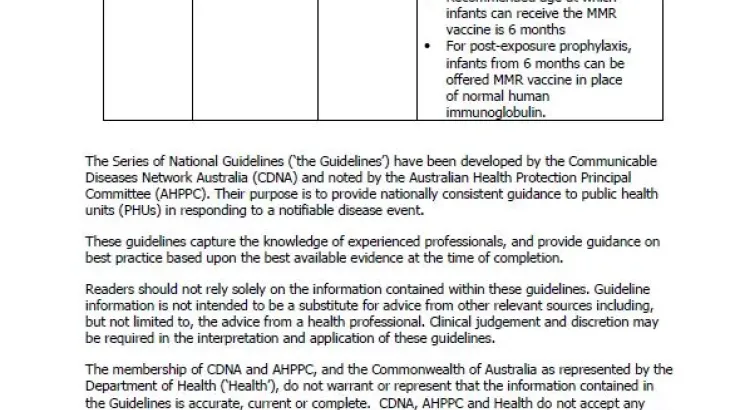
Two doses of measles-containing vaccine are recommended for all people born during or after 1966, from 12 months of age. About 99% of people are immune to measles after receiving 2 vaccine doses.
People born before 1966 are generally considered immune to measles, unless a blood test has shown otherwise. This is because the virus was prevalent in the community at that time, and most people were exposed to measles.
Infants aged 6 to 12 months who are travelling to countries where measles is endemic, or where there is an outbreak, may receive measles-containing vaccine, after an individual risk assessment.
These infants still need an additional 2 doses of measles-containing vaccine from 12 months of age to be considered immune to measles.
Measles-containing vaccines contain live attenuated viruses and should not be given to:
See the Australian Immunisation Handbook for more information, and who is eligible for free measles vaccination under the National Immunisation Program.
Control of measles relies on effective surveillance and outbreak response activities.
People in certain groups who were born during or after 1966 should check their immunity status. This includes people who are:
Those who do not have immunity against measles are recommended to discuss vaccination with their healthcare professional.
See the Australian Immunisation Handbook for more information.
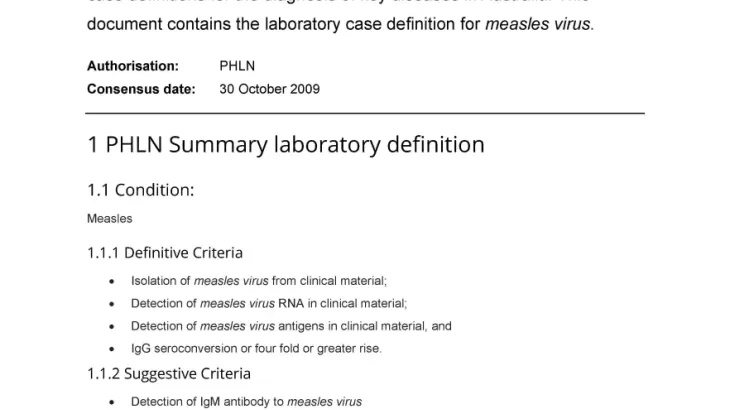
Measles is usually diagnosed through laboratory testing. Measles serology requires a blood sample. Nucleic acid testing requires urine (first catch) and respiratory (nasopharyngeal or throat) specimens.
Read more about measles diagnosis.
There is no specific therapy for treatment of measles. But symptoms and complications can be managed through supportive therapy.
Read more about the clinical management of measles.
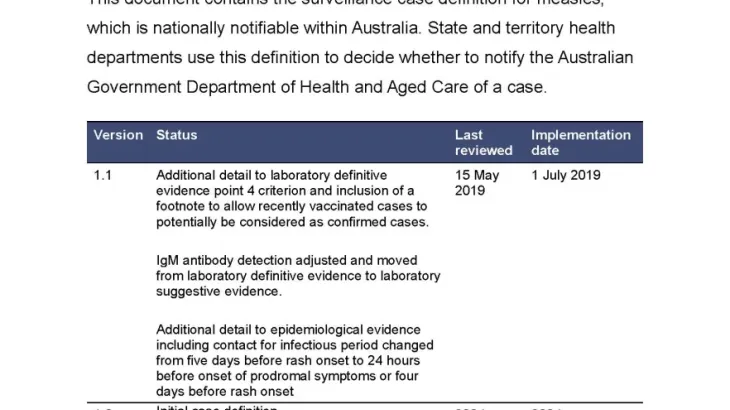
Confirmed and probable cases of measles are nationally notifiable in Australia. This means certain health professionals must report diagnoses through their relevant health authorities.
Check how to report confirmed and probable measles cases in your state or territory:
State and territory health authorities report new cases to us through the National Notifiable Diseases Surveillance System, as part of our surveillance activities.
We report case numbers and activity through our data visualisation tool, where you can filter and search the latest information.
Public health units urgently investigate all suspected, probable and confirmed measles cases. Case management focuses on:
Public health messaging recommends that people who are infectious with measles should:
Hospitalised measles cases are kept in respiratory isolation with airborne precautions applied. The person should use a mask when being transported.
Public health units undertake contact tracing to:
Susceptible contacts may be considered for post-exposure prophylaxis with either:
Eligibility criteria for post-exposure prophylaxis include:
Susceptible and immunocompromised contacts should be excluded from childcare, primary schools and certain work settings, for their own safety and to reduce the risk to others.
Control measures used during outbreaks include:
Infection prevention and control measures should be used when people with suspected measles are seen in healthcare settings. These include:
Special situations and high-risk settings, such as childcare, schools or healthcare facilities, might require extra infection prevention and control actions and public health activities if there is a measles case. These may include:
For more information, see the:
See: