At a glance
- Vaccine preventable – check who’s eligible
- Nationally notifiable disease
About mpox
Mpox (formerly called monkeypox) is caused by infection with MPXV, which is related to the smallpox virus.
Most infections are mild, but in some cases, mpox can cause serious illness.
MPXV has evolved into different types of viruses, named clade I and clade II. Clade I is more likely to cause severe illness and death than clade II.
Why it matters to public health
Mpox has been an important public health problem in some overseas countries for some time.
In 2022, mpox infections increased globally, and the virus spread to new countries that had not had mpox before.
In Australia:
- the first mpox cases were reported in 2022
- 144 cases were reported during a 2022 outbreak
- more than 1,400 cases were reported during a 2024 outbreak
- most reported infections have been acquired in Australia
- almost all cases have been infected with MPXV clade II.
Mpox can be serious, especially for people at greater risk of severe disease. Even for people with mild infections, mpox can be painful and recovery can take many weeks.
Anybody who is exposed to the virus can get mpox. Many cases in Australia have been among gay, bisexual and other men who have sex with men (GBMSM) or people who have sex with people who are GBMSM.
Reducing stigma around mpox is an important public health priority. People at increased risk of exposure need appropriate information and support.
Because of these impacts, we:
- monitor and report on case numbers and trends in Australia
- plan for how to manage major outbreaks.
Symptoms
If you’re looking for advice about your own health or treatment options, see healthdirect or speak with a qualified healthcare professional. Our role is to provide public health advice – information and guidance that helps prevent disease, protect communities and improve wellbeing at a population level.
If you have severe symptoms or are worried, contact your nearest hospital immediately for urgent medical attention.
Common symptoms include:
- rash
- swollen glands in the neck, armpits or groin
- mouth ulcers or sores
- fever
- headache
- sore throat
- rectal pain
- pain in the joints, back or muscles
- extreme tiredness.
Although some people with mpox don’t get a rash, you can get the mpox rash on any part of your body.
It can look like pimple-like lesions or sores and goes through several stages as the disease progresses.
The lesions can be very painful, especially in sensitive areas like the mouth or rectum.
Most people with mpox get better in 2 to 4 weeks.
Mpox can cause serious complications such as:
- skin infection (cellulitis)
- pneumonia
- sepsis
- encephalitis.
healthdirect’s symptom checker can help you work out whether you need to seek medical help.
Onset of symptoms
Symptoms usually start between 3 and 21 days after getting infected.
How it spreads
Over time, the virus has evolved to spread more easily between people.
Mpox usually spreads during close contact with an infected person. This can include through:
- direct skin-to-skin contact with the rash, blisters or sores on the skin – this can happen during sexual contact
- respiratory droplets from coughing or sneezing
- other body fluids, including semen.
Mpox can also spread:
- through contact with contaminated objects – such as linen and towels – after a person with mpox has used them
- to the baby during pregnancy
- to humans from infected animals.
We are still learning about all the ways mpox spreads between people and how often people without symptoms spread the virus to someone else. We monitor the latest evidence.
Infectious period
Mpox can be spread to others from up to 4 days before symptoms start.
People with mpox are considered infectious:
- until all scabs have fallen off and a fresh layer of skin has formed – this usually takes about 2 to 4 weeks
- until all symptoms have gone and 21 days have passed since symptoms began if there are no rashes or lesions
- for 21 days after a positive test if there are no symptoms.
Prevention
Vaccination
Mpox vaccines are available for people at greater risk of exposure or who have been exposed to mpox within the past 14 days. Read about mpox vaccinations available in your state or territory.
Other prevention steps
When mpox is circulating in your community
You should:
- know the symptoms of mpox and what to do if you develop them
- exchange contact details with sexual partners to help with contact tracing
- avoid close contact with anybody with mpox symptoms – have open, non-judgemental conversations with anybody you have intimate contact with about any symptoms either of you may have
- use condoms and perform hand hygiene after condom use – but remember, condoms don’t always protect against transmission
- discuss preventative mpox vaccination with your healthcare professional.
If you have been in contact with a person with mpox
You should:
- see your doctor or healthcare provider immediately to discuss post-exposure vaccination – getting vaccinated within 4 days (and at least within 14 days) of being exposed can reduce your risk of severe illness
- monitor yourself for symptoms for 21 days after you were last exposed
- regularly wash your hands
- cough and sneeze into your elbow or a tissue and immediately throw used tissues in the bin
- avoid settings where there are people at greater risk of severe disease – including childcare, schools and healthcare facilities – except to work or seek medical attention.
If you have had contact with a person with clade I mpox, there may be extra steps you need to take. Your state or territory health department or healthcare professional will advise you.
If you have symptoms you think could be due to mpox
You should:
- see your doctor or healthcare professional immediately
- until they have advised you can resume normal activities, you should:
- avoid close contact – including sexual contact – with other people
- avoid contact with animals
- keep any sores or lesions covered
- regularly wash your hands
- cough and sneeze into your elbow or a tissue and immediately throw used tissues in the bin
- wear a mask when around people or animals if you have a sore throat, cough or any lesions in your mouth
- avoid sharing clothes, bedding, towels, cutlery or crockery with other people
- sleep in a separate bed to other people and use a separate bathroom, if you can.
- avoid contact with people at greater risk of severe disease, and going to places where they are, such as
- childcare
- schools
- healthcare facilities.
- follow your healthcare professional and state or territory health department’s advice.
If travelling
You should:
- follow Smartraveller guidance
- discuss vaccination with your healthcare professional if you are going to a country with mpox clade I.
Follow the advice of your healthcare professional and state or territory health department if you:
- have been diagnosed with mpox
- are suspected of having mpox
- are told you’ve been identified as a contact of an mpox case.
Priority groups and settings
Some people are at greater risk of being exposed to mpox or getting very sick from it.
Mpox can spread quickly in certain settings, including:
- households
- sex-on-premises venues
- events or parties involving intimate or skin-to-skin contact.
If you are at greater risk of severe disease, it is especially important to take steps to protect yourself.
People at greater risk of severe disease
Mpox poses a greater risk of severe illness for people who are:
- children
- immunocompromised (have a weakened immune system)
- living with poorly controlled HIV infection
- pregnant
- unvaccinated.
Children aged under 10 years are more like to get:
- more severe skin lesions
- secondary bacterial infections.
People at greater risk of exposure
People are more likely to be exposed to mpox if they:
- live in the same house as someone with mpox
- travel to areas with mpox
- work with orthopoxviruses in a laboratory
- are healthcare professionals caring for mpox cases or handling contaminated items.
When mpox is circulating in the community, people may be at greater risk of exposure if they are:
- GBMSM, including transgender and gender-diverse people
- people of any gender who have sex with people who are GBMSM
- sex workers.
Read more information for GBMSM and find an mpox vaccination service.
Diagnosis and treatment
Your healthcare professional can diagnose mpox with a test using swabs taken from affected areas.
They may recommend testing for sexually transmissible infections or other diseases that cause similar symptoms at the same time.
You can use healthdirect’s directory to find a health service near you.
Most people with mpox have mild symptoms that they can manage at home by staying hydrated and taking over-the-counter pain medication.
Some patients may need to go to hospital for treatment to manage their symptoms or complications.
Read more about how to manage or treat mpox.
Surveillance and reporting
Mpox is a nationally notifiable disease – these are diseases that present a risk to public health.
Health authorities in each state and territory report new confirmed and probable cases to us through the National Notifiable Diseases Surveillance System.
This is part of our surveillance activities, which help us monitor case numbers around the country and understand disease patterns.
We analyse the data and report on mpox case numbers through our data visualisation tool, where you can filter and search the latest information.
Outbreaks
Public health units respond to mpox outbreaks in high-risk groups and settings. They might:
- provide information about mpox and its symptoms
- ask people who were in a place at the same time as a person with mpox to monitor for symptoms and get tested if they develop symptoms
- recommend post-exposure preventative vaccination or antiviral medication for contacts of mpox cases.
Settings may implement extra infection prevention and control actions to help reduce the spread of mpox. These include:
- ensuring access to handwashing facilities
- providing training in the use of appropriate personal protective equipment
- increasing cleaning and disinfection
- laundering or disposing of soiled items.
Read more about how the Australian Government defines and plans for outbreaks and pandemics.
Support
For more information, see:
- resources about what mpox is, symptoms, treatment and prevention
- ways to prevent the spread of sexually transmissible infections
- sexual health in Australia
- the healthdirect mpox page
- the Emen8 mpox toolkit.
For information about mpox and vaccination in your state or territory see:
- Australian Capital Territory
- New South Wales
- Northern Territory
- Queensland
- South Australia
- Tasmania
- Victoria
- Western Australia.
If you need mental health support, see a list of organisations, websites and services that offer support, counselling and information.
Quick links
- National Guidelines for Public Health Units
- Surveillance case definition
- Laboratory case definition
- Guidance on referral and specimen collection
Disease
Infectious agent
MPXV is an enveloped, double-stranded deoxyribonucleic acid virus of the genus Orthopoxvirus, which also includes variola virus (which causes smallpox).[1]
MPXV has 2 distinct genetic clades – I and II, each with 2 subclades – a and b.
The natural reservoir of MPXV is unknown. The virus has been isolated from several species of African rodents and primates.[2]
Read more about the different clades of MPXV.
Clinical presentation
Mpox is usually self-limiting with symptoms lasting 2 to 4 weeks.
The illness may start with prodromal symptoms including:
- lymphadenopathy (swollen lymph nodes)
- fever
- headache
- myalgia (muscle pain)
- arthralgia (joint pain)
- back pain
- sore throat.
A maculopapular rash usually appears 1 to 5 days after the fever starts. It can be widespread or localised.
The rash progresses through several stages:
- flat spots (macules)
- raised bumps (papules)
- clear fluid-filled blisters (vesicles)
- pus-filled sores (pustules).
These sores eventually crust over and scab, usually within 14 to 21 days. They often leave behind scars.
The mpox rash can involve very few or no visible lesions, especially for clade IIb infections. When sexually acquired, lesions might only appear in the oral or anogenital regions.
Mpox can cause severe pain, especially if lesions are in sensitive areas like the mouth or rectum.
Complications of mpox can include:
- secondary infections
- pneumonia
- sepsis
- encephalitis
- infection of the cornea with scarring and loss of vision.
Reinfections and infections in vaccinated people can occur, but the clinical presentation might be milder.
Read more about the clinical features of mpox.
Public health importance
Mpox can spread widely and cause severe illness, particularly in children and people who are immunocompromised.
The World Health Organization (WHO) has declared mpox a Public Health Emergency of International Concern twice since 2022. This is due to changes in disease epidemiology, including increasing case numbers and spread to new countries.
Over time, the virus that causes mpox has mutated to spread more easily between humans.
Surveillance and prevention activities, including vaccination and public health communications, help control outbreaks and protect priority populations.
Mpox primarily spreads through close contact, including sexual contact, and can spread quickly through sexual networks. Anyone who is exposed to mpox can be infected.
In Australia, a high proportion of cases have been among gay, bisexual and other men who have sex with men (GBMSM).
Reducing stigma around mpox infection is an important public health priority to ensure priority populations and people exposed to mpox:
- have access to appropriate and accessible information and support
- seek testing and treatment
- can access mpox vaccination.
Epidemiology
Since 2022, a global outbreak of mpox clade IIb has resulted in more than 100,000 cases in 127 countries. Many cases in this outbreak have been in males, primarily GBMSM.
Since late 2023, an outbreak of clade Ib cases has been reported in the Democratic Republic of the Congo and neighbouring countries. Cases have been reported in several countries outside Africa, among people who travelled to epidemic regions.
Globally, infections with clade Ia have been associated with higher mortality rates than other subtypes.[3]
In Australia:
- the first mpox cases were reported in 2022
- 144 cases were reported during a 2022 outbreak
- more than 1,400 cases were reported during a 2024 outbreak
- cases have almost all been MPXV clade IIb
- most reported infections have been acquired in Australia.
For the latest information on cases of mpox in Australia see the National Communicable Disease Surveillance data visualisation tool.
See more global mpox case data, including deaths.
Spread of infection
Transmission
Mpox mainly transmits directly through close or intimate contact with an infected person. This can be through broken skin or via mucous membranes in the:
- respiratory tract – including nose and mouth
- conjunctiva
- genitalia
- perianal region.[4]
This includes through sexual contact.[5]
It can also be spread through:
- indirect contact via materials or objects contaminated with the virus, such as towels, clothes or bed linen
- respiratory droplets, particularly during prolonged face-to-face contact
- other body fluids, such as blood or semen
- aerosol generating procedures and aerosol dispersing activities
- vertical transmission
- contact with animals.
Incubation period
The incubation period ranges from 3 to 21 days.
A very small proportion of people might develop symptoms after 21 days from exposure.[6]
Infectious period
People can be infectious from 4 days before the onset of symptoms until both:
- symptoms have resolved
- all scabs have fallen off and a fresh layer of skin has formed.[7]
This normally takes 2 to 4 weeks.
People with no visible lesions are considered infectious until 21 days after the start of their symptoms, provided all symptoms have resolved.
Asymptomatic people are considered infectious for 21 days after a positive test.
Priority populations
People at greater risk of severe disease
Mpox poses a greater risk of severe illness for people who are:
- unvaccinated
- immunocompromised
- living with poorly controlled HIV infection
- pregnant
- children.
Children aged less than 10 years are at higher risk of:
- more extensive skin lesions
- complications such as secondary bacterial infections
- severe disease and poor outcomes.[8]
Pregnant people with mpox are at higher risk of miscarriage and stillbirth.[9]
Read more about mpox in:
People at greater risk of exposure
People are more likely to be exposed to mpox if they:
- live in the same house as an infected person
- travel to areas where mpox is endemic
- work with orthopoxviruses in a laboratory
- are caring for mpox cases or handling contaminated items, such as healthcare workers.
When mpox is circulating in the community, people may be at greater risk of exposure if they are:
- GBMSM, including transgender and gender-diverse people
- any gender and have sex with people who are GBMSM
- sex workers.
See what measures can prevent mpox infection.
Settings at increased risk of spread
Mpox can spread in settings where there is likely to be close, sustained physical contact between people.
These include:
- households
- venues that offer sex-on-premises
- parties or other social events where intimate contact occurs
- healthcare settings where mpox cases are being cared for.
Aboriginal and Torres Strait Islander communities might be at greater risk of spread due to:
- overcrowded housing
- reduced access to healthcare.
Depending on the nature of cases and disease spread, public health units may take extra steps to reduce the risk to people in the community. Community actions must be co-designed and culturally appropriate.
Prevention
Vaccination
Primary preventive vaccination is recommended for people at greater risk of exposure to mpox, including:
- GBMSM
- sex workers
- people living with HIV, if they are at risk of mpox exposure
- people who work in a laboratory with orthopoxviruses
- people of any sexual orientation or gender identity travelling to countries with transmission of MPXV clade I, who may undertake sexual risk activities.
Primary preventive vaccination can also be considered for:
- healthcare or humanitarian workers at risk of occupational exposure to mpox
- sexual partners of:
- GBMSM
- sex workers
- people living with HIV.
Post-exposure preventive vaccination may be offered to contacts of an mpox case to reduce their risk of becoming infected.
See the Australian Immunisation Handbook for more information about mpox vaccination and what is available in your state or territory.
Other prevention steps
When mpox is circulating in the community, prevention measures include:
- educating people on the symptoms of mpox and what to do if they develop them
- advising people to:
- use barrier methods such as condoms during sex – but be aware they may not prevent transmission
- avoid close contact with anyone with mpox or mpox symptoms
- exchange contact information with sexual partners to assist with contact tracing
- avoid sex-on-premises venues or events where intimate contact occurs
- follow Smart Traveller guidance if considering travel to a country where mpox is endemic.
Prevention among priority populations
People at greater risk of exposure should:
- know the symptoms of mpox
- get vaccinated, if eligible
- see a healthcare professional immediately if they are exposed to mpox or develop symptoms.
See more mpox resources.
Diagnosis and clinical management
Diagnosis
Mpox is usually diagnosed through laboratory testing using nucleic acid amplification testing.
The type of specimen collected depends on whether lesions are present and their stage. Specimens include:
- lesion fluid
- lesion tissue or crust
- skin biopsy
- anorectal swab.
A full screen for HIV and sexually transmissible infections is often done at the same time.
Read more about mpox:
- diagnosis and management in primary care
- patient referral and testing
- infection prevention and control precautions for healthcare settings.
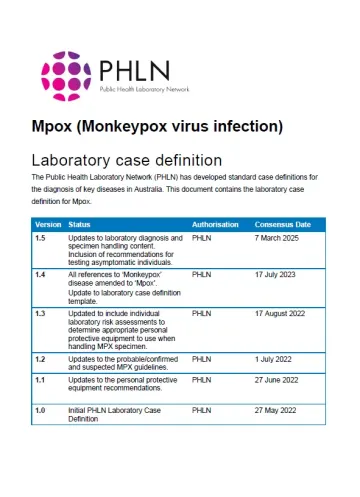
Laboratory case definition
Monkeypox – Laboratory case definition
Clinical management
Mpox is usually a self-limiting disease with symptoms lasting 2 to 4 weeks. Most people don’t need specific treatment. Some patients require supportive therapy, such as medications to manage their pain.
People with severe mpox or complications, or those at high risk of severe disease, may be prescribed an antiviral medication.
Read more about:
- clinical management of mpox
- infection prevention and control precautions for mpox in healthcare settings.
Notification and reporting
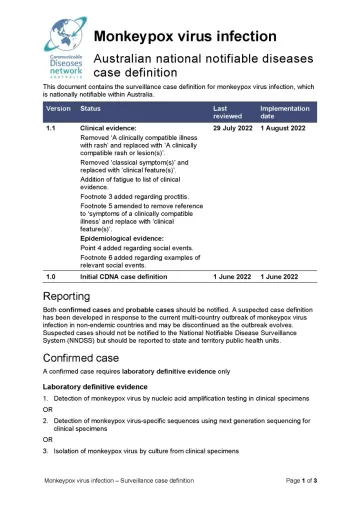
Surveillance case definition
Monkeypox virus infection – Surveillance case definition
National notification and reporting
Confirmed and probable mpox cases are nationally notifiable in Australia. This means certain health professionals must report diagnoses through their relevant health authorities.
Check how to report confirmed and probable mpox cases in your state or territory:
- Australian Capital Territory
- New South Wales
- Northern Territory
- Queensland
- South Australia
- Tasmania
- Victoria
- Western Australia.
State and territory health authorities report new cases to us daily through the National Notifiable Diseases Surveillance System.
We report case numbers through our data visualisation tool, where you can filter and search the latest information, as part of our surveillance activities.
This helps us to:
- identify trends in mpox cases in the community
- understand the demographic groups at increased risk
- develop policies to minimise the impact of mpox.
Public health response
National public health guidelines
Mpox – CDNA National Guidelines for Public Health Units
Management of cases
Public health units urgently investigate all confirmed, probable and suspected mpox cases. The public health management of cases focuses on:
- identifying the likely source of infection
- assessing the likelihood of MPXV clade I infection
- identifying any contacts
- preventing transmission.
Public health units generally advise people with mpox to:
- avoid close or intimate contact with others, including all sexual activity
- avoid contact with animals
- keep lesions covered with a waterproof dressing when around people or animals
- avoid entering high-risk settings such as health and aged care settings, unless seeking medical attention
- wear a mask when around other people or animals if they have lesions in the mouth or any respiratory symptoms
- avoid contact with people who are at higher risk of severe disease
- practice careful hand and respiratory hygiene.
To help prevent spread of mpox within households, people with mpox should:
- limit contact with other household members as much as possible
- sleep in a separate bedroom and use a separate bathroom, if they can
- not share clothing, bedding or towels
- clean and disinfect any shared spaces or items after use.
Public health units may recommend extra precautions, such as isolation, where there is a reasonable suspicion of infection with MPXV clade I.
The public health unit or treating clinician will advise the person when they have been cleared to resume normal activities.
For 12 weeks after clearance, people who have had mpox should:
- wear a condom during all types of sexual activity
- not donate blood, cells, organs, breastmilk, tissue or semen.
Management of contacts
Public health units undertake contact tracing to:
- identify all potential contacts
- provide advice and public health education
- provide post-exposure preventive vaccination, if appropriate.
Post-exposure prophylaxis (PEP) may be offered to contacts of an mpox case to reduce their risk of becoming infected. This may involve vaccination or antiviral medication.
Read more about PEP with vaccination and antiviral medications.
Other contact management actions may include:
- monitoring for mpox symptoms
- urgent testing if symptoms develop
- vaccination (if not already fully vaccinated)
- advice to:
- abstain from sexual activity for 21 days from the last exposure
- avoid contact with people at increased risk of severe disease
- not donate blood, cells, tissue, breast milk, semen or organs
- avoid high-risk settings, such as childcare and aged care facilities, where possible.
Exclusions and restrictions may apply for workers in some high-risk settings.
Public health units may recommend extra precautions, such as advice to work from home, where there is a reasonable suspicion of contact with a case infected with MPXV clade I.
Outbreak response
The way public health units respond to mpox outbreaks depends on the setting and nature of the outbreak.
In some special situations and high-risk settings, specific control measures, including post-exposure preventive vaccination, may be implemented to manage outbreaks.
Enhanced infection prevention and control measures may also reduce the risk of transmission. This may include:
- ensuring access to handwashing facilities
- providing training in the use of appropriate personal protective equipment
- increasing cleaning and disinfection
- laundering or disposing of soiled items.
Special situations and high-risk settings
Extra public health actions may be implemented in some special situations and high-risk settings when mpox is circulating in the community or a case is identified. These include:
- residential aged care homes
- other residential settings, such as disability facilities
- healthcare facilities – see the Australian guidelines for the prevention and control of infection in healthcare
- Aboriginal and Torres Strait Islander communities
- childcare centres and schools
- sex-on-premises venues and clubs
- infections with MPXV clade I.
Prevention and control measures in these settings can include:
- providing information about mpox and its symptoms
- asking people who were at the venue to monitor for symptoms and get tested if they develop symptoms
- considering post-exposure preventive vaccination
- tailored health education and messaging.
Resources
See the:
- Australian Immunisation Handbook
- Australian STI management guidelines for use in primary care
- mpox treatment guidelines
- Mpox CDNA National Guidelines for Public Health Units
- healthdirect mpox page.
For information about mpox and vaccination in your state or territory see:
References
- 1 R Sah, BK Padhi et al., 'Public Health Emergency of International Concern declared by the World Health Organization for monkeypox', Global Security: Health, Science and Policy, 2022, 7(1):51–56. doi:10.1080/23779497.2022.2124185.
- 2 E Alakunle, U Moens et al., 'Monkeypox virus in Nigeria: Infection biology, epidemiology, and evolution', Viruses, 2020, 12(11):1257. doi:10.3390/v12111257.
- 3 EM Bunge, B Hoet et al., 'The changing epidemiology of human monkeypox: A potential threat? A systematic review', PLOS Neglected Tropical Diseases, 2022, 16(2):e0010141. doi:10.1371/journal.pntd.0010141.
- 4 D Pan, J Nazareth et al., 'Transmission of monkeypox/mpox virus: A narrative review of environmental, viral, host, and population factors in relation to the 2022 international outbreak', Journal of Medical Virology, 2023, 95(2):e28534. doi:10.1002/jmv.28534.
- 5 G Sberna, G Rozera et al., 'Role of direct sexual contact in human transmission of monkeypox virus, Italy', Emerging Infectious Diseases, 2024, 30(9):1829–1833. doi:10.3201/eid3009.240075.
- 6 F Miura, CE van Ewijk et al., 'Estimated incubation period for monkeypox cases confirmed in the Netherlands, May 2022', Euro Surveillance: Bulletin Europeen sur les Maladies Transmissibles: European Communicable Disease Bulletin, 2022, 27(24):2200448. doi:10.2807/1560-7917.ES.2022.27.24.2200448.
- 7 I Brosius, C Van Dijck et al., 'Presymptomatic viral shedding in high-risk mpox contacts: A prospective cohort study', Journal of Medical Virology, 2023, 95:e28769. doi:10.1002/jmv.28769.
- 8 AM Beeson, J Haston et al., 'Mpox in children and adolescents: Epidemiology, clinical features, diagnosis, and management', Pediatrics, 2023, 151(2):e2022060179. doi:10.1542/peds.2022-060179.
- 9 DA Schwartz, 'High rates of miscarriage and stillbirth among pregnant women with clade I mpox (monkeypox) are confirmed during 2023–2024 DR Congo outbreak in South Kivu Province', Viruses, 2024, 16(7):1123. doi:10.3390/v16071123.
- 10 GN Okoli, P Van Caeseele et al.,'A global systematic evidence review with meta-analysis of the epidemiological characteristics of the 2022 mpox outbreaks,' Infection, 2024, 52:901–921. doi:10.1007/s15010-023-02133-5.