Last updated:
Disease groups:
Polio is a highly contagious viral disease. It can lead to long-term disability and death. In Australia, the risk of polio is low, but vaccination is still important. We monitor and report on polio cases and wastewater detections and provide guidelines to minimise the risk.
Polio is a highly contagious infection caused by the poliovirus.
It can cause long-term disability, paralysis and death.
There is no cure for polio, but it can be prevented with vaccination.
Before the introduction of vaccination, polio was a major cause of death and disability.
Because of global efforts to eradicate polio, the number of cases diagnosed each year has decreased by more than 99% since the 1980s.
In Australia, the risk of polio is low. Australia maintains high polio vaccination coverage through the National Immunisation Program.
Australia has been polio-free since 2000, but vaccination is still important because outbreaks occur in neighbouring countries.
Because of this we:
If you’re looking for advice about your own health or treatment options, see healthdirect or speak with a qualified healthcare professional. Our role is to provide public health advice – information and guidance that helps prevent disease, protect communities and improve wellbeing at a population level.
Most people with polio have no or mild symptoms. Symptoms include:
Some people also experience more severe symptoms, like:
These symptoms usually resolve within 1 to 2 weeks. But in a very small number of cases, it progresses to paralytic polio.
In paralytic polio, symptoms include:
Other serious complications include weakness of the breathing muscles, which can cause death.
People who have recovered from polio, especially more severe disease, can develop post-polio syndrome years later.
healthdirect’s symptom checker can help you decide whether to see a doctor.
Read more about:
Symptoms usually start between 7 and 14 days after exposure to the virus, but this can range from 2 to 35 days.
Poliovirus is highly contagious. It mainly spreads from one person to another through food, water or items contaminated with the faeces of an infected person.
Less often, it can spread through saliva or respiratory droplets.
The virus can survive outside the human body for several weeks.
People with polio are infectious from about 7 to 10 days before symptoms appear and can remain infectious for many weeks.
People are usually most infectious just before and after symptoms start, but can be infectious even if they don’t have any symptoms.
Vaccination is the only way to protect against polio. The inactivated polio vaccine (injectable) is safe and highly effective.
Vaccination is recommended for all:
An additional vaccine dose is recommended every 10 years for:
Eligible people can get polio vaccination for free under the National Immunisation Program or state or territory programs. If you are not eligible for free vaccination, you can buy one from your healthcare professional or some pharmacies.
People who have not had a polio vaccination in the past 10 years are at greater risk of getting sick from polio if they are exposed to the virus.
If you are at greater risk, it is especially important to talk to your health professional about polio vaccination.
Polio can spread quickly in:
Polio poses a greater risk of severe illness for:
You are at greater risk of exposure to polio if you travel to countries where the virus is circulating.
Talk to your doctor about polio vaccination before you travel.
People who work in certain jobs – like healthcare or laboratory workers – may be at greater risk of exposure to polioviruses.
Your health professional can diagnose polio through a test, which usually requires a stool sample.
You can use healthdirect’s directory to find a health service near you.
There is no cure for polio. Some treatments – like supportive care in hospital and physiotherapy – can help people recover and reduce complications.
Polio is a nationally notifiable disease – these are diseases that present a risk to public health.
Health authorities in each state and territory report confirmed cases to us through the National Notifiable Diseases Surveillance System.
This is part of our surveillance activities, which help us monitor case numbers around the country and understand disease patterns.
We analyse the data and report on case numbers and other data through our data visualisation tool, where you can filter and search the latest information.
We also do wastewater surveillance for polio, and publish annual reports for the polio surveillance program.
A detection of polio in Australia triggers a public health response. Public health actions focus on quickly finding and isolating infected people to prevent further spread.
Contact tracing is done to find people who might have been exposed to an infected person. Contacts might be offered vaccination to reduce their risk of getting polio.
Read more about how the Australian Government defines and plans for outbreaks and pandemics.
For information about polio in your state or territory see:
If you need mental health support, see a list of organisations, websites and services that offer support, counselling and information.
For information for polio survivors, see Polio Australia.
For information about polio if travelling, see Smartraveller.
Poliovirus has 3 serotypes: types 1, 2 and 3. Type 1 is the most virulent and widespread, responsible for most paralytic polio cases and epidemics. Type 3 was declared globally eradicated in 2019.
Polioviruses can be categorised into:
Vaccine-derived poliovirus can circulate in under-immunised populations, particularly in areas where OPV is still used. Australia now exclusively uses the inactivated poliovirus vaccine, rather than OPV.
Humans are the only known natural host and reservoir of polioviruses.
At least 95% of polio cases are asymptomatic.[2]
There are different clinical types of polio, which range in severity.
Abortive polio occurs in about 4% to 8% of cases. In this type of polio, there is no neurological involvement. Clinical features are mild and self-limiting such as:
Non-paralytic polio is more severe than abortive polio and can present with signs of meningeal irritation, such as:
Non-paralytic polio usually resolves within 1 to 2 weeks but a very small proportion of cases progress to paralytic polio.
In paralytic polio, additional clinical features include:
Paralysis develops over 2 to 3 days, with legs more commonly affected than arms. Severity ranges from partial involvement of one muscle to complete quadriplegia. About 2 in 3 people with acute flaccid paralysis will not regain full strength.
Other serious complications can include:
Post-polio syndrome can occur years after initial infection in people who partially or fully recovered.
Read more about symptoms, diagnosis and treatment of polio
Polio is a serious viral disease that can lead to long-term disability, paralysis and death. There is no cure, but it is preventable with a safe and very effective vaccine.
Before the introduction of widespread vaccination, polio was a major global health problem. In 1988, the World Health Assembly adopted a Global Polio Eradication Initiative. Since then, the global incidence of polio has decreased by 99%.
In Australia, the risk of polio is low. Australia maintains high polio vaccination coverage through the National Immunisation Program.
The World Health Organization has declared the risk of international spread of poliovirus constitutes a Public Health Emergency of International Concern.
Because of this, we:
Australia, along with the WHO Western Pacific Region, was verified as polio-free in 2000.
Since 1987, only one case of polio caused by wild poliovirus has been reported in Australia. This case occurred in 2007 in a person who acquired their infection in Pakistan.[3]
No locally acquired cases of polio have been reported in Australia since the 1970s.
Globally, wild poliovirus remains endemic in Pakistan and Afghanistan.
The death rate for paralytic polio is:
In Australia, deaths caused by polio have been rare since the 1950s.[5]
For the latest information on poliovirus cases in Australia see the:
Poliovirus is highly contagious. It mainly transmits through the faecal–oral route.
Less often, transmission can occur through saliva or respiratory secretions.
Poliovirus can survive outside the human body for several weeks.
Symptoms, if present, usually start between 7 and 14 days after exposure to the virus, but this can range from 2 to 35 days.
Cases are infectious from about 7 to 10 days before the onset of symptoms.
Cases are usually most infectious in the days immediately before and after the onset of symptoms, but asymptomatic cases are also infectious.
The virus may be present in the faeces for many weeks.[2]
People who are immunocompromised might shed the virus for longer.
People at greater risk of severe disease and complications from polio may include those who are:
See what measures people can take to protect themselves.
People are more likely to be exposed to the virus if they:
See what measures people can take to protect themselves.
Settings at increased risk of poliovirus spread include:
Polio vaccination is provided free under the National Immunisation Program. The inactivated polio vaccine (injectable) is safe and highly effective.
Vaccination against polio is recommended for all:
An additional dose of polio vaccine is recommended every 10 years for:
See the Australian Immunisation Handbook for more information, and who is eligible for free polio vaccination under the National Immunisation Program.
People who may be exposed to poliovirus through their work must follow their workplace health and safety advice.
Control of polio relies on effective surveillance and outbreak response activities.
Read more about global efforts to eradicate polio.
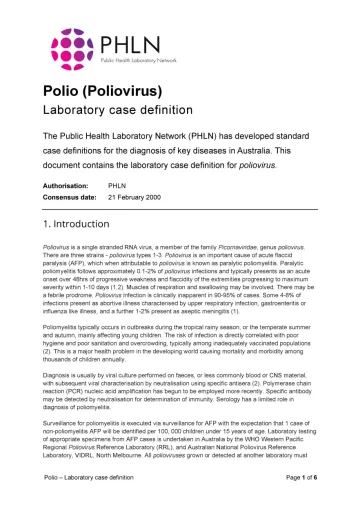
Polio is diagnosed through laboratory testing in patients presenting with clinical features suggestive of the disease.
A sample of faeces is usually used for diagnosis.
Nucleic acid amplification testing (such as polymerase chain reaction or PCR) is routinely used to detect enteroviruses.
In clinically compatible cases, specimens are referred for further testing for poliovirus at the National Enterovirus Reference Laboratory (NERL) in Melbourne. This includes culture and whole genome sequencing.
Under the Global Polio Eradication Initiative, all polioviruses need to be physically contained in designated poliovirus essential facilities (PEF). The NERL is Australia’s PEF.
Polioviruses and any material potentially infectious for poliovirus – like faeces – must not be handled outside of a PEF.
The clinical management of polio is largely supportive and includes pain management and physiotherapy.
Mechanical ventilation may be required where respiratory failure develops.
There are no approved antiviral therapies for polio.
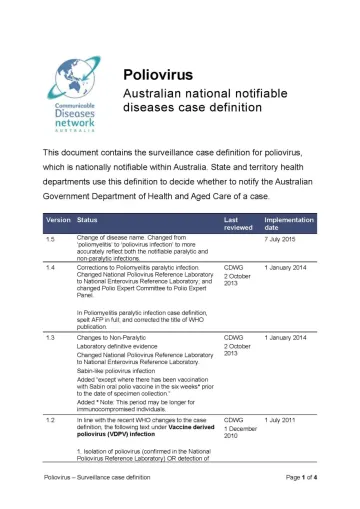
In Australia, surveillance for acute flaccid paralysis in children under 15 years is conducted to detect potential poliovirus circulation in the community. This is in line with polio guidance from the World Health Organization.
We also track suspected polio cases and wastewater detections through the polio surveillance program.
This helps us to:
Polio is a nationally notifiable disease. This means certain health professionals must report confirmed and probable polio cases through their relevant health authorities.
Check how to report confirmed and probable polio cases or related death in your state or territory:
State and territory health authorities report new cases to us through the National Notifiable Diseases Surveillance System as part of our surveillance activities.
We report case numbers and other data through our data visualisation tool, where you can filter and search the latest information.
We also publish annual reports for the polio surveillance program.
The Poliovirus detection outbreak response plan for Australia outlines the response actions required for a suspected polio case or wastewater detection.
Public health authorities urgently investigate all confirmed and probable polio cases. Case management focuses on:
People with polio who are infectious are isolated for at least 14 days from onset of symptoms until they have fully recovered.
Two negative stool samples collected 7 days apart are needed to confirm a person with polio is no longer infectious.
Hospitalised polio cases are cared for using standard contact and droplet precautions.
Read more about:
Public health units undertake contact tracing to:
Priority is given to managing contacts who work in settings where they could potentially spread the virus to many people – such as healthcare, childcare and food handling settings.
Unvaccinated contacts are recommended to get vaccinated. Contacts who have not had a polio vaccine dose within the previous 10 years are offered a booster dose.
Quarantine for 7 days may be recommended for some contacts, depending on their exposure.
All contacts are provided with information about polio including:
Any detection of polio is considered a national public health emergency, requiring a rapid response. The primary goal of the response is containment of potential poliovirus spread.
Response actions might include:
Laboratory personnel exposed to poliovirus during a high-risk laboratory incident are quarantined for 7 days.
See: