Last updated:
Disease groups:
Tuberculosis is a bacterial infection that usually affects the lungs. People with tuberculosis disease in their lungs can spread it to others through airborne transmission. Early treatment of people with tuberculosis is the best way to prevent serious illness and spread to others.
Tuberculosis is an infectious disease caused by the bacterium Mycobacterium tuberculosis.
It usually affects the lungs but can also affect other parts of the body including the brain, bones or kidneys.
People with tuberculosis can carry the bacteria for months or years without becoming sick because their immune system keeps it under control – this is called tuberculosis infection.
When the bacteria multiply and the immune system can no longer control the infection, symptoms appear and the infection can spread to others – this is called tuberculosis disease.
Tuberculosis is one of the world’s deadliest infectious diseases. It causes about 1.3 million deaths globally each year.
Tuberculosis is less common in Australia compared with other countries – most people diagnosed with tuberculosis in Australia were likely exposed overseas. But the risk of tuberculosis can be higher for people in Aboriginal and Torres Strait Islander communities.
Tuberculosis bacteria have evolved to become resistant to some antibiotics. This means laboratory testing is important for choosing the right medication for each person affected by tuberculosis. Drug resistant tuberculosis is uncommon in Australia. Detecting these infections is critical to prevent further spread of resistant strains.
Because of these important health impacts, we:
If you’re looking for advice about your own health or treatment options, see healthdirect or speak with a qualified healthcare professional. Our role is to provide public health advice – information and guidance that helps prevent disease, protect communities and improve wellbeing at a population level.
About 1 in 10 people infected with Mycobacterium tuberculosis become unwell with tuberculosis disease.
Common symptoms of tuberculosis disease in the lungs include:
Tuberculosis disease that affects other parts of the body can have a wide range of symptoms, depending on where the infection is.
healthdirect’s symptom checker can help you decide whether to see a health professional.
Symptoms of tuberculosis disease may appear weeks or months after infection.
People who are immunocompromised and young children might develop symptoms sooner.
Only people with tuberculosis disease can spread the disease to other people.
People with tuberculosis infection (but not tuberculosis disease) are not infectious.
When someone with tuberculosis disease in their lungs talks, breathes, coughs or sneezes, tiny droplets or particles carrying the bacteria are released. If another person breathes these in, they can become infected.
Tiny particles containing the bacteria can stay in the air for several hours – especially in small or poorly ventilated spaces.
Tuberculosis is more likely to spread when people spend a long time together.
People with tuberculosis disease in parts of the body other than the lungs are usually not infectious.
Tuberculosis does not spread through:
People with tuberculosis disease who aren’t effectively treated can be infectious for many weeks, months or even years.
People who receive effective treatment are usually no longer infectious after treatment begins.
Public health authorities take action to prevent tuberculosis. This includes:
People migrating to Australia who fall within certain groups – such as healthcare workers from countries with a higher prevalence of tuberculosis – are also screened for tuberculosis infection as part of their visa requirements. If found to be infected, they will be offered treatment.
In Australia, tuberculosis vaccination is only recommended for certain groups, including:
Talk to your healthcare professional or contact your state or territory immunisation health service.
Apart from vaccination, the best way to protect against tuberculosis is to seek the advice of a healthcare professional if:
They might recommend testing or preventative treatment.
Some people are at greater risk of getting tuberculosis or getting very sick from it.
Tuberculosis poses a greater risk of severe illness for:
People might be at greater risk of being exposed to tuberculosis if they:
Testing and treatment for tuberculosis is available without cost to the person through all Australian public hospitals and tuberculosis programs – regardless of a person’s citizenship or Medicare eligibility.
Healthcare professionals diagnose tuberculosis using:
A skin prick test might be done if a person has been exposed to someone with tuberculosis.
If tuberculosis is present outside the lungs, other tests might be needed.
You can use healthdirect’s directory to find a health service near you.
Treatment involves a combination of antibiotics for at least 6 months. The required treatment period might be longer for drug-resistant or multi-drug-resistant infections.
Treatment is determined and managed by a medical specialist.
Read more about how to manage or treat tuberculosis.
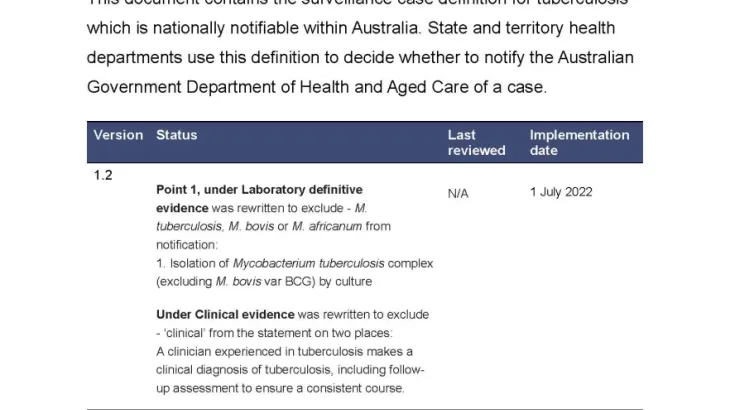
Tuberculosis is a nationally notifiable disease – these are diseases that present a risk to public health.
Health authorities in each state and territory report new cases to us through the National Notifiable Diseases Surveillance System.
This is part of national surveillance activities to monitor case numbers around the country and understand disease patterns.
We analyse the data and report on case numbers and other data through our:
The public health response to a tuberculosis outbreak is led and coordinated by state and territory health authorities. The response might include:
For information about tuberculosis in your state or territory, see:
If you need support, see:
For travel advice, see Smartraveller.