Last updated:
Disease groups:
West Nile/Kunjin virus spreads to people through the bites of infected mosquitoes. Infections in people are rarely reported but can be serious. Preventing mosquito bites is the best protection.
Kunjin virus is a strain of West Nile virus that occurs in Australia. Other West Nile virus strains occur in other parts of the world.
West Nile/Kunjin virus can spread to people through the bites of infected mosquitoes.
Most people with West Nile/Kunjin virus infection have mild or no symptoms. But in rare cases, the virus can cause encephalitis, which can lead to long-term health problems or death.
There is currently no vaccine or specific treatment for West Nile/Kunjin virus infection.
A One Health approach is important to help detect, prevent and control West Nile/Kunjin virus. This is because interactions between animals, mosquitoes, people and the environment cause its spread.
West Nile/Kunjin virus circulates between mosquitoes and birds – mainly waterbirds. Other animals can also become infected.
The virus circulates mainly in northern Australia, especially during the summer wet season. But it can also occur in other parts of mainland Australia, especially after heavy rainfall or flooding, which can increase waterbird and mosquito numbers.
Infections in people are rarely reported, but most have occurred in northern Australia.
If you’re looking for advice about your own health or treatment options, see healthdirect or speak with a qualified healthcare professional. Our role is to provide public health advice – information and guidance that helps prevent disease, protect communities and improve wellbeing at a population level.
Most people with West Nile/Kunjin virus infection do not get any symptoms.
If symptoms do occur, they can include:
Rarely, people infected with the virus develop encephalitis (brain inflammation).
healthdirect’s symptom checker can help you decide whether to see a health professional.
Symptoms usually start within 4 weeks after infection.
West Nile/Kunjin virus can spread to people through the bites of mosquitoes after they have fed on infected birds and animals.
The species of mosquito that spreads the virus usually bites at dusk and dawn, but bites can occur at other times of day.
West Nile/Kunjin virus does not normally spread between people.
There is no vaccine available for West Nile/Kunjin virus infection.
The best protection against the virus is to prevent mosquito bites.
West Nile/Kunjin virus infection may pose a greater risk of severe illness for:
People might be at greater risk of exposure to the virus if they work, live or visit areas where West Nile/Kunjin virus has been detected. The risk might also be higher near rivers, wetlands or flooded areas.
You can use healthdirect’s directory to find a health service near you.
Health professionals can diagnose West Nile/Kunjin virus infection with a blood test.
They may also collect a sample of cerebrospinal fluid (the fluid around the brain and spinal cord) for testing.
There is no specific treatment for West Nile/Kunjin virus infection. People with encephalitis usually require hospital care.
Read more about:
West Nile/Kunjin virus infection is a nationally notifiable disease – these are diseases that present a risk to public health.
Health authorities in each state and territory report new cases to us through the National Notifiable Diseases Surveillance System.
This is part of national surveillance to monitor case numbers and understand disease patterns.
Public health authorities take a One Health approach to the surveillance of West Nile/Kunjin virus infection. In addition to human disease surveillance, relevant government departments help monitor the virus in mosquitoes and animals, including wildlife.
Use our data visualisation tool to search the latest data.
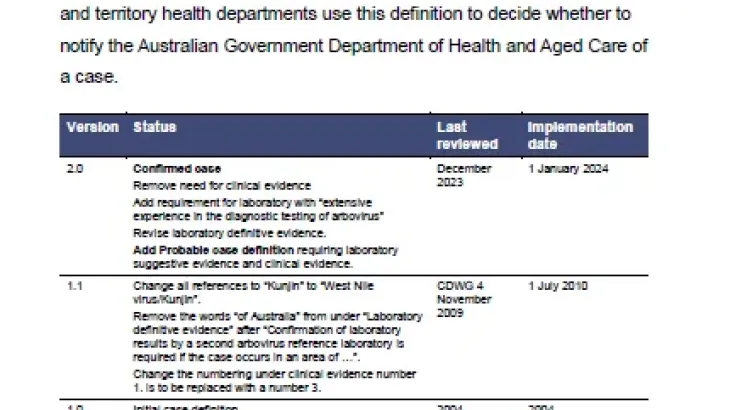
Read the West Nile/Kunjin virus infection surveillance case definition.
For information about West Nile/Kunjin virus infection in your state or territory, see:
If you need mental health support, see a list of organisations, websites and services that offer support, counselling and information.
For travel advice, see Smartraveller.