Last updated:
Disease groups:
Whooping cough (pertussis) is a highly contagious respiratory disease. It spreads through respiratory droplets and can be serious, especially for babies. Getting vaccinated is the best protection. We monitor and report on pertussis in our community, including national case numbers and trends.
Whooping cough (pertussis) is a highly contagious respiratory disease caused by the bacterium Bordetella pertussis.
People with whooping cough can have severe coughing fits. The cough can linger for weeks or even months.
Vaccination is the best way to prevent whooping cough.
Whooping cough can cause severe disease, and even death.
People with whooping cough can be contagious for several weeks and spread the disease to others they have contact with.
It is most serious for babies who are too young to be fully vaccinated, so protecting babies and pregnant people from infection is an important public health priority.
In 2024, more than 57,000 cases of whooping cough were reported in Australia. This was the highest yearly number since we started recording whooping cough cases in 1991.
Children aged 5 to 14 years made up more than half of all reported cases (57%) in 2024.
Whooping cough can spread quickly in homes, schools and other settings.
Because of these major impacts we monitor and report on cases in Australia. Check the latest case numbers using our data visualisation tool.
If you’re looking for advice about your own health or treatment options, see healthdirect or speak with a qualified healthcare professional. Our role is to provide public health advice – information and guidance that helps prevent disease, protect communities and improve wellbeing at a population level.
Common symptoms in the first week of illness include:
After 1 to 2 weeks, the cough usually gets worse, and there can be long episodes of heavy coughing. These episodes can sometimes end in vomiting.
The ‘whoop’ sound between coughing episodes is caused by taking a quick breath. But this doesn’t always happen.
Babies and young children might not cough but might have trouble breathing.
healthdirect’s symptom checker can help you decide whether to see a healthcare professional.
Symptoms usually start 7 to 10 days after getting infected, but this can range from 4 to 21 days.
Whooping cough can spread easily through respiratory droplets and secretions from your respiratory tract. When you cough, sneeze, speak or sing, these droplets spread through the air and land on people or surfaces.
People can catch whooping cough by:
People with whooping cough can infect others from when their first symptoms begin. You are considered infectious until either:
Eligible people – including children and pregnant people – can get vaccines for free under the National Immunisation Program or state or territory programs. If you are not eligible for a free vaccine, you can buy one from your healthcare professional or pharmacy.
The protection you get from the whooping cough vaccine wears off over time, so check with your healthcare professional to see whether you need a booster dose.
The best way to protect against whooping cough is to get vaccinated.
Vaccination:
Getting vaccinated also helps to protect babies who are too young to be fully vaccinated and other people who aren’t immune.
Other ways to protect yourself against whooping cough include:
Other ways to protect others against whooping cough include:
Read more ways to prevent whooping cough.
Some people are at greater risk of getting whooping cough or getting very sick from it.
Whooping cough can spread quickly in homes and other settings including:
If you are at greater risk, or have regular contact with somebody at greater risk, it is especially important to:
Whooping cough poses a greater risk of severe illness for:
Anyone can get whooping cough, but people may be at greater risk of being exposed to whooping cough if they:
Your healthcare professional can diagnose whooping cough with a test. The sample is usually collected from the nose or throat with a swab and sent to a laboratory for testing.
Read more about diagnosing whooping cough.
You should see your healthcare professional if you think you or your child might:
You can use healthdirect’s directory to find a health service near you.
Your healthcare professional might prescribe antibiotics to treat whooping cough. Antibiotics can reduce your risk of spreading whooping cough to other people.
Read more about how to manage or treat whooping cough.
Whooping cough (pertussis) is a nationally notifiable disease – these are diseases that present a risk to public health.
Health authorities in each state and territory report new confirmed and probable cases to us daily through the National Notifiable Diseases Surveillance System.
This is part of our surveillance activities, which help us monitor case numbers around the country and understand disease patterns.
We analyse this data, and report on whooping cough case numbers through our data visualisation tool, where you can filter and search the latest information.
Outbreaks of whooping cough tend to occur every few years in Australia and worldwide. Outbreaks can happen at any time of the year.
Outbreaks can occur in some groups and settings.
During outbreaks, state and territory governments might take extra public health actions to prevent further infections. These can include:
Read more about how the Australian Government defines and plans for outbreaks and pandemics.
For information about whooping cough in your state or territory see:
For travel advice, see Smartraveller.
Pertussis is caused by the bacteria Bordatella pertussis, a gram-negative coccobacillus.
B. pertussis only infects humans. There is no known animal or environmental reservoir.
Pertussis is a prolonged coughing illness. Clinical presentation varies with age and immunity (from vaccination or previous infection).
The initial (catarrhal) phase is characterised by upper respiratory tract symptoms including:
The cough gradually worsens over the next 1 to 2 weeks and can become paroxysmal. This is when severe, heavy coughing occurs in a series during a single expiration. The cough can last 2 to 8 weeks and can involve:
Serious complications can include:
Infants, especially those younger than 6 months, might present with more severe disease and need hospitalisation for complications. These can include:
Read more about symptoms, diagnosis and treatment of pertussis.
Pertussis is a highly contagious, vaccine-preventable bacterial respiratory illness. It can cause severe disease, complications and death, particularly in infants aged under 6 months.
People with whooping cough can be contagious for several weeks, which means there may be many opportunities to pass on the infection.
The pertussis vaccine is safe and highly effective in protecting people from infection and serious complications of pertussis.
This highlights the importance of:
Pertussis infections are common in Australia, with epidemics occurring every 3 to 4 years. Although there is no clear seasonal pattern, pertussis notifications generally peak during early November.[1]
Before the COVID-19 pandemic, between 2016 and 2019, pertussis was responsible for:
In 2024, Australia recorded the highest number of pertussis notifications since we started recording in 1991. More than 57,000 cases were reported, with the highest notification rate in children aged 9 to 11 years.
Since routine pertussis vaccination during pregnancy began in 2015, the pertussis notification rate in infants aged under 2 months has fallen.[3]
But pertussis hospitalisations for this age group remain a concern, as they have:
For the latest information on pertussis cases in Australia, see our data visualisation tool.
Pertussis is mainly transmitted by respiratory droplets that are aerosolised when an infected person coughs.
Less commonly, transmission may occur by direct contact with the respiratory secretions of an infected person.
Outside the human body, B. pertussis can only survive for a few hours in respiratory secretions.
Indirect spread through fomites is rare.
The incubation period is usually 7 to 10 days, but can range from 4 to 21 days.
Cases are considered infectious from the onset of symptoms until the earlier of either:
Pertussis poses a greater risk of severe illness for:
Read more about:
People may be more likely to be exposed to pertussis if they:
See what measures people can take to protect themselves.
Pertussis can spread quickly in homes and other settings, including:
An outbreak of pertussis in these settings may require a public health response.
Pertussis-containing vaccines have been shown to be highly effective for preventing severe disease in children and reducing the risk of symptomatic disease. But immunity wanes over time.
Routine vaccination is recommended for:
Routine booster vaccination is recommended for adults who are in special risk groups or in contact with a special risk group, such as:
See the Australian Immunisation Handbook for more information, and who is eligible for free pertussis vaccination under the National Immunisation Program.
Other prevention measures include:
Vaccination in all recommended populations helps protect priority populations, including babies. This is due to both:
Pertussis is diagnosed through laboratory testing of nasopharyngeal swabs or aspirates. Throat swabs are sometimes used, although these are not as sensitive.
Samples are most often tested using nucleic acid testing (NAT) or culture.
After the fourth week of cough, testing is less likely to detect bacterial DNA in the nasopharynx. But NAT can be positive for 5 weeks or longer.
Pertussis can also be diagnosed using serological testing (via a blood test). Serology can be useful for illnesses present for more than 2 weeks but IgA and IgG may remain elevated for a long time after vaccination.

Pertussis is treated with antibiotics.
Treatment should be initiated as soon as possible. Early antibiotics can reduce the period of communicability.
Read more about the clinical management of pertussis.
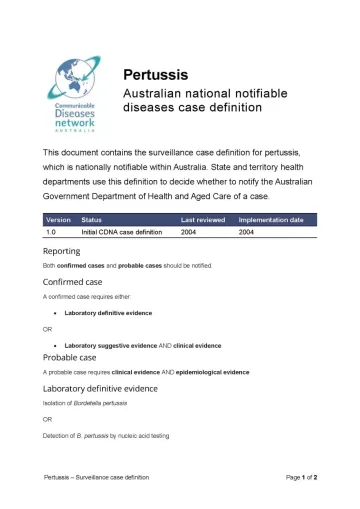
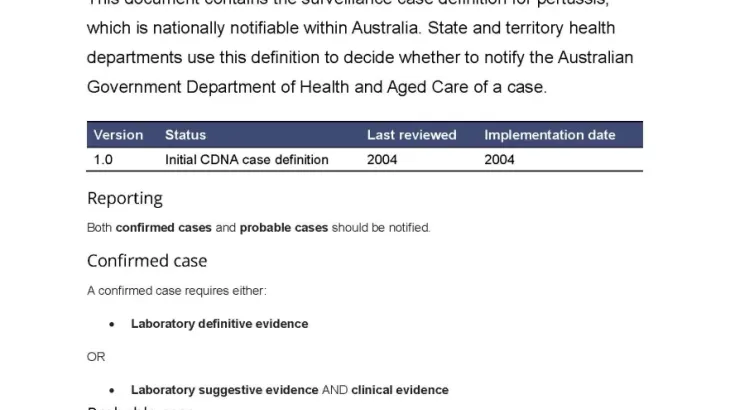
Confirmed and probable cases of pertussis are nationally notifiable in Australia. This means certain health professionals must report diagnoses through their relevant health authorities.
Check how to report laboratory-confirmed pertussis cases or related death in your state or territory:
State and territory health authorities report new cases to us through the National Notifiable Diseases Surveillance System, as part of our surveillance activities.
We report case numbers and other data through our data visualisation tool, where you can filter and search the latest information.
Public health units investigate high-priority confirmed pertussis cases, including:
Case management focuses on:
People with pertussis infection should:
Public health units and medical professionals identify potential high-risk contacts, where possible to:
Antibiotic prophylaxis may be offered to:
Unvaccinated or incompletely vaccinated contacts should avoid childcare settings where there are children aged under 6 months until either:
Public health agencies responses to pertussis cases and outbreaks depends on:
Control measures used during outbreaks may include:
Special situations and high-risk settings might require extra infection and control actions. These include cases in:
See the: