Last updated:
Disease groups:
Australian bat lyssavirus (ABLV) causes a rare but fatal disease. The best prevention is not touching bats. Anyone bitten or scratched by a bat should immediately wash the wound and seek urgent medical attention.
Australian bat lyssavirus (ABLV) is closely related to the rabies virus. It is unique to Australia.
Any bat in Australia, including flying foxes, could carry ABLV.
ABLV causes a rare but serious disease in people and some other animals.
It most often spreads to people through a bite or scratch from an infected bat. Anyone who might have been exposed to ABLV should take urgent action to reduce their risk of getting ABLV.
Even people who have had previous vaccination for rabies need to seek urgent medical attention if they are exposed – they might need extra vaccine doses.
Human ABLV infections are rare. When it does occur, ABLV infection causes a serious illness which is almost always fatal.
Because of the seriousness of ABLV infections, we work with colleagues in the animal and environmental sectors to ensure a One Health coordinated approach to preventing, monitoring and reporting on ABLV.
If you’re looking for advice about your own health or treatment options, see healthdirect or speak with a qualified healthcare professional. Our role is to provide public health advice – information and guidance that helps prevent disease, protect communities and improve wellbeing at a population level.
ABLV infections have a similar clinical presentation to rabies.
The illness usually starts with flu-like symptoms that may last from a few days to weeks. Common symptoms include:
The illness then progresses to:
Once symptoms begin, ABLV infection usually causes death within 1 to 2 weeks.
People who have been bitten or scratched by a bat should not wait for symptoms to develop and should see a healthcare professional urgently.
Read more about symptoms, diagnosis and treatment of ABLV.
Symptoms usually start weeks to months after exposure to the virus, but this can be up to several years.
ABLV has been found in bats, including flying foxes, in Australia.
People can be infected when the saliva of an infected animal enters their body through:
The urine, faeces and blood of infected bats are not known to be infectious.
Many types of animals can be infected with ABLV, but only bats are known to infect people.
ABLV does not usually spread between people.
The infectious period for people infected with ABLV infection is unknown.
The best way to protect yourself from ABLV is not to touch bats. If you encounter a sick or injured bat, contact your local licensed wildlife rescue organisation.
ABLV is vaccine preventable – the same vaccines are effective against ABLV and rabies.
Vaccination is recommended for people who are at greater risk of exposure through their work or other activities. These include:
If you have been scratched or bitten by a bat:
If bat saliva gets in your eyes, nose or mouth:
You should consider all bats in Australia to be potentially infected and able to transmit ABLV.
Your doctor might recommend:

People who are unvaccinated are at greater risk of severe illness and death.
People who might have contact with bats are at greater risk of ABLV infection. This includes people who work, volunteer, or undertake other activities with bats.
Laboratory staff who work with live lyssaviruses are also at greater risk of exposure.
If you are at greater risk of exposure to ABLV, it is especially important to:
ABLV infection can be diagnosed with a test, which might require:
The sample used depends on the stage of the disease.
You can use healthdirect’s directory to find a health service near you.
There is no specific treatment for ABLV. Once symptoms develop, ABLV is almost always fatal.
Read more about how to manage or treat ABLV infection.
ABLV is a nationally notifiable disease – these are diseases that present a risk to public health.
Health authorities in each state and territory report new human cases to us through the National Notifiable Diseases Surveillance System.
This is part of national surveillance to monitor case numbers and understand disease patterns.
Use our data visualisation tool to search the latest data.
Read more about reporting on ABLV in bats.
For information about ABLV infection in your state or territory see:
Read more about:
If you need mental health support, see a list of organisations, websites and services that offer support, counselling and information.
Australian bat lyssavirus (ABLV) is a member of the Rhabdoviridae family, genus Lyssavirus. It is closely related to rabies virus, which is also a Lyssavirus. There are 2 known variants of ABLV. [1] [2]
ABLV is unique to Australia. Any bat in Australia is considered able to carry and transmit ABLV.
ABLV infections in humans have a similar clinical presentation to classical rabies.
Initial (prodromal) symptoms may last from a few days to weeks, and typically include:
One of 2 major clinical forms of disease then develops.
Encephalitic or furious rabies occurs in about 80%[3] of symptomatic patients and causes:
Paralytic rabies occurs in about one-third of patients. It causes ascending flaccid paralysis of limbs and respiratory muscles but has little impact on consciousness until late in their course of disease.
ABLV typically causes death from heart or respiratory failure within 1 to 2 weeks of symptom onset.
Read more about symptoms, diagnosis and medical management of ABLV.
ABLV is a public health priority in Australia due to its near 100% fatality rate in humans once symptoms appear.
Although bat bites and scratches are rare, they require urgent medical management and are associated with significant psychological burden.
Because of the seriousness of human ABLV infections, we work with colleagues in the animal and environmental sectors at the national and state and territory levels to ensure a One Health coordinated approach to monitoring and reporting of ABLV.
There have been 4 reported cases of human ABLV infections in Australia – all have been fatal. These cases were reported in Queensland in 1996, 1998 and 2013, and New South Wales in 2025. ABLV became nationally notifiable in 2001.[4] [5] [6] [7]
The prevalence of ABLV in Australian bat populations is estimated to be less than 1% in healthy bats, but is higher in bats that are sick, injured or orphaned.[8]
In 2013, ABLV was also detected in 2 horses in Australia.[9]
For the latest information on human ABLV cases in Australia see the National Notifiable Diseases Surveillance System (NNDSS) data visualisation tool.
ABLV is transmitted to people through exposure to the saliva of infected bats through a scratch or bite. There is currently no evidence of human-to-human transmission of ABLV.
Other possible modes of transmission, based on rabies virus transmission, include:
Blood, urine and faeces are not considered to be infectious.
The incubation period for ABLV is not well-established. It is thought to be similar to rabies virus, which has an incubation period of 5 days to several years (usually 2 to 3 months).[10] [11]
The incubation period may vary depending on factors such as:
The infectious period for humans infected with ABLV is unknown.
Any person who is unvaccinated is at risk of severe disease if infected.
Read more about measures people can take to protect themselves.
The risk of exposure is greater for:
See what measures people can take to protect themselves.
Pre-exposure vaccination is recommended for people who are at greater risk of exposure to the virus through their work or other activities.
Post-exposure vaccination is recommended for people who may have been exposed to ABLV.
See the Australian Immunisation Handbook for more information.
The best protection against ABLV infection is to avoid contact with bats.
People should only handle bats if they:
WIRES Rescue Line (call 1300 094 737) can refer callers to experts trained in bat handling and rescue in each state and territory.
If a potential ABLV exposure has occurred, the treating clinician must notify the local public health unit immediately.
To minimise the risk of infection following a potential exposure to ABLV, treating clinicians must:
To guide the management of the exposure, the public health unit will contact the person to determine:
The public health unit must also be notified if there is uncertainty about whether an exposure event did occur, including if there was contact with a dead bat. They will contact the person to:
If the bat involved in the exposure event is available, the public health unit might arrange testing for ABLV.
See the Communicable Diseases Network Australia (CDNA) national guidelines for public health units for detailed guidance on the management of potential ABLV exposures.
Vaccination is the best protection against ABLV for people at greater risk of exposure. This includes any recommended booster doses.
It is important people handling bats are trained in their safe handling – this includes using appropriate personal protective equipment.
ABLV is diagnosed through laboratory testing in symptomatic patients where ABLV is considered as a possible cause.
The sample used for testing depends on the stage of the disease and may include:
A specialist microbiologist should be contacted for advice about specimen collection and the testing process.
Diagnosis may also be made post-mortem using brain tissue.
Appropriate clinical management is essential to prevent ABLV infection after an exposure event.
There is no known effective treatment for symptomatic ABLV infection. People with ABLV require hospital-based care.
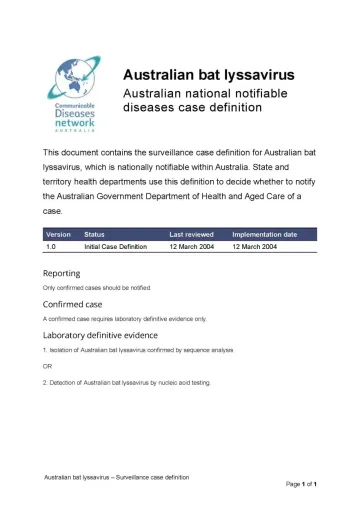
ABLV infection in humans is a nationally notifiable disease. This means certain health professionals must report diagnoses through their relevant health authorities.
Check how to report laboratory-confirmed ABLV infection cases or related death in your state or territory:
State and territory health authorities report new cases to us daily through the National Notifiable Diseases Surveillance System, as part of our surveillance activities.
We report case numbers through our data visualisation tool, where you can filter and search the latest information.
This helps us to:
We take a One Health approach to the surveillance of ABLV. As well as human surveillance, we work with government agencies for agriculture and the environment to monitor ABLV in bats.
Testing in bats may also occur:
See Wildlife Health Australia.
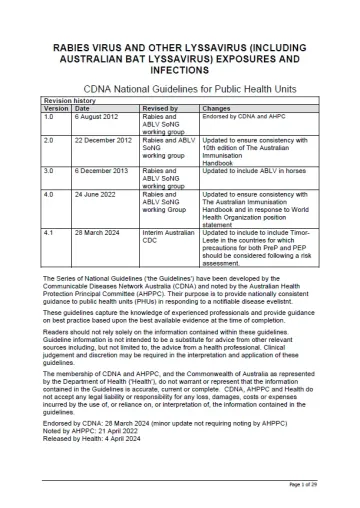
Public health units investigate all confirmed human cases of ABLV and suspected cases where the clinical picture is highly suspicious of ABLV.
Case management focuses on determining:
Public health units urgently undertake active case finding for other people who may have been exposed and assess the need for post exposure prophylaxis.
Urgent veterinary advice should be sought for any exposed animals.
Public health units undertake contact tracing of human ABLV cases to:
Some situations might require the public health unit to follow up, in conjunction with animal health authorities where indicated. These include where there is:
See: