Last updated:
Disease groups:
Rabies is a rare but fatal disease that affects the brain and central nervous system. Anyone bitten or scratched by an animal overseas should seek urgent medical attention. The best prevention is not touching animals while overseas. We monitor rabies overseas and provide guidelines for exposures.
Counterfeit (fake) rabies vaccines have been circulating in India since 2023. People who received the fake vaccine may not be fully protected against rabies.
If you received a rabies vaccine in India on or after 1 November 2023, speak to a healthcare professional to see whether you need replacement doses.
See the ATAGI guidance for travellers and healthcare providers for more information.
Rabies is a rare but fatal disease that affects the central nervous system.
It is caused by a type of virus called a lyssavirus.
Rabies virus is found in nearly every country, but not Australia. It is closely related to Australian bat lyssavirus and causes a very similar disease.
Rabies spreads to people through bites or scratches from infected animals.
Rabies is a serious public health problem in many countries.
It almost always causes death if not appropriately managed after exposure to the virus.
It can be controlled by vaccination of people and dogs, but about 59,000 people around the world still die from rabies each year.
Because of these major impacts, we:
Read more about rabies overseas.
If you’re looking for advice about your own health or treatment options, see healthdirect or speak with a qualified healthcare professional. Our role is to provide public health advice – information and guidance that helps prevent disease, protect communities and improve wellbeing at a population level.
Rabies usually starts with flu-like symptoms that may last for a few days to weeks. Common symptoms include:
The illness then progresses to include:
Death usually occurs within 2 weeks of symptoms starting.
Read more about the symptoms, diagnosis and treatment of rabies.
If you have been in contact with an animal overseas (especially bats, dogs, cats and monkeys) where there is any risk of rabies, urgently see a healthcare professional.
Symptoms usually start between 2 and 3 months after getting infected. But this can range from 1 week to 1 year, or even longer.
Rabies virus spreads through the saliva of infected mammals, such as:
The virus usually spreads to people through bites or scratches. But people can also be infected if saliva comes in contact with their eyes, mouth, nose or an open wound.
In areas where rabies is not well controlled, at least 9 in 10 people with rabies are infected by dogs.
Rabies does not usually spread between people.
The best protection is to avoid contact with animals while travelling overseas, especially if they are sick or injured.
If you get scratched or bitten by an animal while travelling overseas, act quickly to prevent infection – seek immediate medical attention, even if you are vaccinated.
Rabies is vaccine preventable – the same vaccines are effective against rabies and Australian bat lyssavirus.
Rabies vaccination is recommended for:
Rabies vaccination (along with rabies immunoglobulin) is also given to people who might have been exposed to rabies.
If travelling overseas to countries where animals have rabies, you can reduce your risk by:
If bitten or scratched by an animal while travelling overseas:
Your doctor may recommend:
For travel advice, see Smartraveller.
Rabies is always a serious disease.
People who are unvaccinated are at greater risk of severe illness and death.
People are at greater risk of exposure to rabies if they travel to countries where rabies is present, especially if they have contact with animals.
Laboratory staff who work with live lyssaviruses are also at greater risk of exposure.
If you are at greater risk, talk to your healthcare professional about rabies vaccination.
Rabies can be diagnosed with a test, which may require:
You can use healthdirect’s directory to find a health service near you.
Once symptoms appear, there is no specific treatment for rabies. People with symptoms need to be cared for in hospital.
Read more about how to manage or treat rabies.
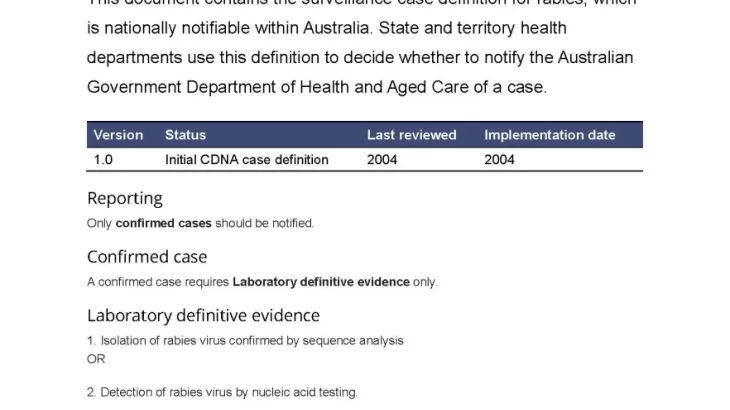
Rabies is a nationally notifiable disease – these are diseases that present a risk to public health.
Health authorities in each state and territory report new laboratory confirmed cases to us daily through the National Notifiable Diseases Surveillance System.
We take a One Health approach to rabies surveillance activities.
For information about rabies in your state or territory, see:
If you need mental health support, see a list of organisations, websites and services that offer support, counselling and information.