Last updated:
Disease groups:
Smallpox is a highly contagious disease caused by a virus. In the past, it was a major public health problem and caused millions of deaths globally. Smallpox was eradicated in 1980 through vaccination – this remains one of the greatest public health successes in history.
Smallpox is a serious disease caused by the variola virus.
It is similar to the virus that causes mpox.
Smallpox no longer occurs anywhere in the world.
Smallpox is one of the deadliest communicable diseases. It is also highly contagious.
The World Health Organization (WHO) declared smallpox eradicated in 1980 following its Smallpox Eradication Program.
Before then, millions of people around the world died from smallpox. People who survived were often left with permanent complications, including severe scarring.
Australia’s last officially recorded smallpox case was in 1938.
Today, people could only be exposed to smallpox if the virus was misused in an act of bioterrorism or biocrime. The Australian Government regulates handling of the virus to minimise this risk.
Only 2 secure laboratories in the world keep the virus for research. Australian laboratories do not store it.
If you’re looking for advice about your own health or treatment options, see healthdirect or speak with a qualified healthcare professional. Our role is to provide public health advice – information and guidance that helps prevent disease, protect communities and improve wellbeing at a population level.
Common initial symptoms include:
After a few days, a rash of fluid-filled blisters develops in the mouth and spreads all over the body. These blisters crust over and form scabs.
Complications of infection include:
Read more about the symptoms, diagnosis and treatment of smallpox.
Initial symptoms usually start between 7 and 19 days after getting infected. The rash then develops 2 to 3 days later.
Smallpox spreads between people through:
People with smallpox are infectious from when the fever starts. They are most contagious once the rash develops and for about 7 to 10 days afterwards.
Smallpox vaccination is no longer routinely given.
Vaccination is recommended for laboratory workers who work with smallpox-related viruses.
Some smallpox vaccines are used to prevent mpox.
There is currently no risk of smallpox.
Smallpox would pose a greater risk of severe disease for:
Only laboratory staff who work with variola virus are at risk of exposure.
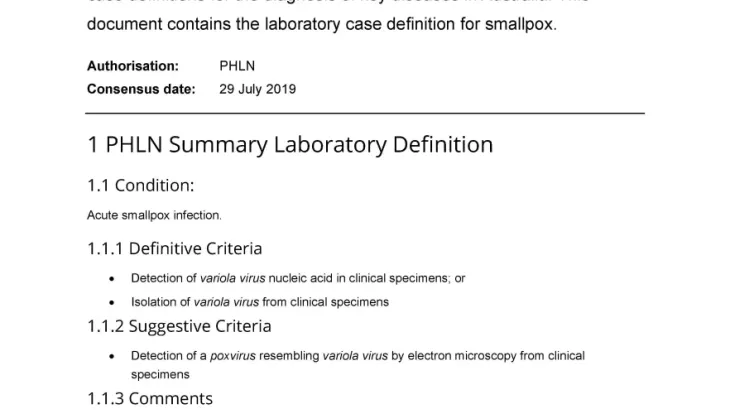
Smallpox can be diagnosed through a test using samples of:
Anyone with smallpox would be isolated and treated in a hospital designated to manage dangerous infectious diseases.
There is no specific treatment for smallpox.
Read more about how to manage or treat smallpox.
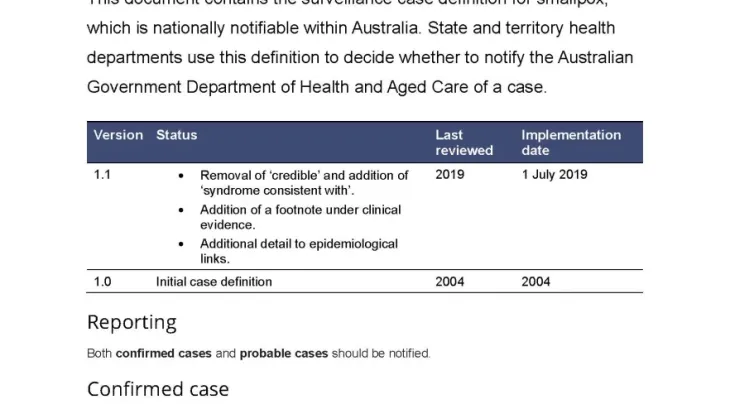
Smallpox is a nationally notifiable disease – these are diseases that present a risk to public health.
Because of how serious it can be, smallpox is a listed human disease. This means the Australian Government can use special powers to respond quickly if it’s detected.
It would only take one person with suspected smallpox to trigger an outbreak response.
Australia keeps an emergency supply of smallpox vaccine to use in case of an outbreak.
Read more about how the Australian Government defines and plans for outbreaks and pandemics.
For information about smallpox in your state or territory, see:
If you need mental health support, see a list of organisations, websites and services that offer support, counselling and information.