
Last updated:
About the program
People infected with communicable diseases can shed the virus when they:
- use the toilet
- shower
- wash their hands
- wash clothing.
The program involves:
- collecting and testing samples of wastewater in sentinel sites across Australia for selected viruses
- analysing results
- publishing national results in an interactive dashboard and reports.
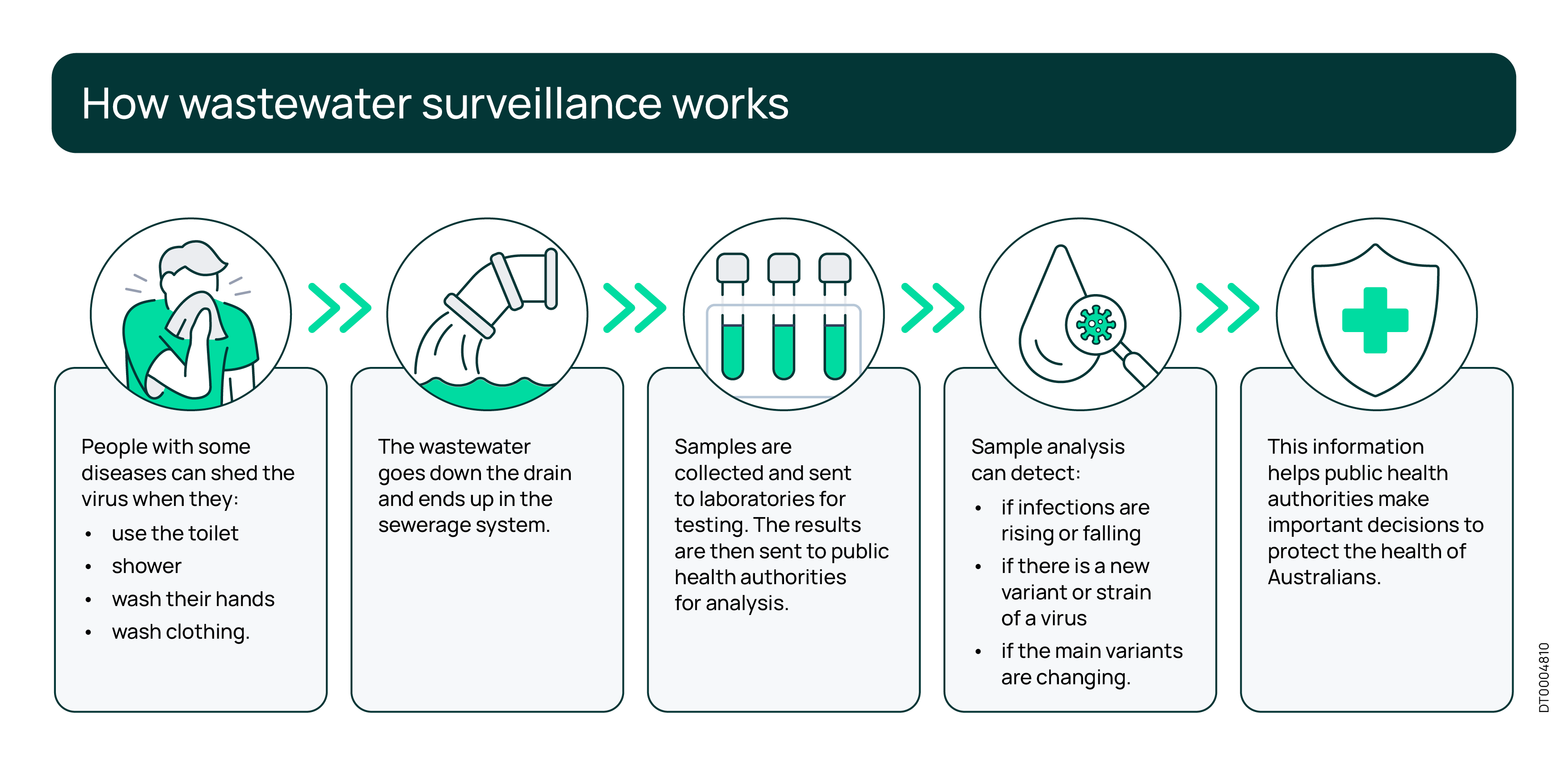
How wastewater surveillance works
- People with some diseases can shed the virus when they:
- use the toilet
- shower
- wash their hands
- wash clothing.
- The wastewater goes down the drain and ends up in the sewerage system.
- Samples are collected and set to laboratories for testing. The results are then sent to public health authorities for analysis.
- Sample analysis can detect:
- if infections are rising or falling
- if there is a new variant or strain of a virus
- if the main variants are changing.
- This information helps public health authorities make important decisions to protect the health of Australians.
We monitor national priority viruses such as:
- SARS-CoV-2, the virus that causes COVID-19
- influenza A and B
- respiratory syncytial virus (RSV)
- poliovirus.
We will be able to adjust the program to monitor and test for other emerging and re-emerging pathogens, such as:
This work will help us quickly detect potential threats and take action.
Sentinel sites
We worked with state and territory governments to select the 48 sentinel sites for this program. These sites support effective national surveillance because of their:
- population size
- potential for disease incursion (such as airports)
- potential to detect early spread and rise in infections.
Why it matters
Wastewater surveillance can detect diseases in a community, regardless of whether people:
- show symptoms
- access health care
- get tested
- report test results.
It is a non-intrusive and anonymous method of monitoring diseases, which provides valuable, early information without identifying individuals.
It provides us with an early warning for potential health threats, such as:
- emerging diseases
- rises or falls in infections
- new variants or strains of concern
- changes in dominant variants.
This enables all levels of government to:
- understand disease trends and potential demand on our health system
- plan for resource allocations, such as hospital beds, staffing and intensive care unit occupancy
- make decisions about whether to take action, what action to take and where to take action
- evaluate whether public health actions – such as vaccination programs – are working.
Incorporating wastewater surveillance into our system was a key recommendation of the COVID-19 Response Inquiry for immediate action.
Data dashboard
A public dashboard will provide timely, high-level information on wastewater trends and signals. The dashboard will go live when sufficient data has been collected to enable meaningful analysis and interpretation of trends.
Our role
We will manage and have oversight of the program, including:
- governing the program, in consultation with the state and territory governments
- analysing and interpreting data
- regularly evaluating and reviewing the program.
The program will initially run for 3 years. We will evaluate it regularly to help determine whether it is effective and should continue.
We have engaged Promoting Health4All (PH4A) Pty Ltd as the supplier of sampling and laboratory testing services for the national program via an open tender process. PH4A will work with laboratories, water utilities and research institutions from across Australia to collect, test and analyse wastewater samples.
In conjunction with the supplier, we are working with state and territory governments to deliver an effective program that meets our collective needs.
Related programs
Read more about:
- communicable diseases
- our communicable diseases surveillance activities.